


 |


| Quantity: | |
|---|---|
Forging hydraulic cylinder barrel φ940*φ700*2130mm
ETERNAL
Detailed Paremeter
1.Cylinder barrel material: | Forging C45 |
2.Cylinder barrel size: | φ940*φ700*2130mm |
3.Cylinder barrel weight: | 5020kg |
4.Cylinder barrel heat treatment: | Normalizing |
5.Hydraulic cylinder max work pressure: | 31.5MPA |
6.Hydraulic cylinder max thrust: | 1200 tons |
7.Carry out 100% pressure testing before shippment. | |
Application
The hydraulic cylinder barrel is applicable to various heavy-duty hydraulic cylinder for all kinds of hydraulic press machines.

Extrusion press hydraulic cylinder

Casting press hydraulic cylinder

Hot press hydraulic cylinder

Forging press hydraulic cylinder

Injection press hydraulic cylinder
Product Procedure
Ingot / Round steel blanking → Heating & forging to form cylinder blank → Normalizing after forging → Rough turning of both ends & outer circle → Rough boring of inner hole → Quenching and tempering heat treatment → Secondary stress relief annealing → Semi-finish boring → Finish boring → Inner hole honing / roller burnishing → Cylinder bottom / flange welding → Post-weld stress relief → Finish turning of outer circle, end face & sealing surface → Non-destructive testing → Hydrostatic / hydraulic pressure test → Cleaning and rust prevention.
Raw Materials: Large continuous casting ingot of 45 steel / large-size round steel
Heating Regime: Uniform heating at 1180~1220℃ with holding for thorough heating
Open die forging → Punching → Mandrel drawing → Round sizing, to form thick-walled tubular blanks
Final forging temperature ≥ 800℃. Low-temperature forging is strictly prohibited to avoid forging cracks.
Normalizing shall be conducted immediately after forging: 830~850℃, air cooling.
Functions: Refine forged grains, eliminate residual forging stress, improve machinability, and prevent blank cracking.

Cut to fixed length by sawing / gas cutting with reasonable machining allowance reserved;
Heavy-duty lathe: Facing both ends and rough turning the outer circle;
Deep hole drilling & boring machine: Rough boring of inner hole;
Single-side reserved machining allowance: 4~6 mm;
Correct defects such as eccentricity, uneven wall thickness and bending caused by forging.
45 steel cylinder tubes must undergo quenching and tempering to improve overall strength, toughness and resistance to internal pressure deformation.
Quenching: Holding at 820~840℃ → water quenching
High-temperature Tempering: Holding at 560~620℃ → air cooling
Hardness: HB 220~260
Tensile Strength ≥ 650 MPa
Yield Strength ≥ 355 MPa
Functions: Ensure pressure resistance, burst resistance and fatigue resistance of cylinder tubes.
Supplement: Low-temperature stress relief annealing at 530~560℃ shall be performed after tempering to release cutting stress from rough machining and completely avoid deformation in subsequent finish machining.
Semi-finish boring → Finish boring to guarantee the basic precision of inner hole straightness and cylindricity.
Option A (Preferred, for hydraulic press cylinders): Heavy-duty honing
Option B (Cost-effective solution): Cold rolling
Machine welding grooves; preheat thick-walled components to 120~180℃.
Adopt submerged arc welding / CO₂ gas shielded welding, with carbon steel welding wires of matching material selected.
Post-welding stress relief annealing at 550℃ to eliminate welding residual stress and prevent weld cracking and fluid leakage in service.
Finish turn the outer circle, positioning steps and mounting flange sealing surfaces at both ends;
Turn inner hole clamping grooves, dustproof grooves, oil port threads and flange sealing positions.
Test critical dimensions including inner diameter, roundness, cylindricity, straightness and wall thickness uniformity.
Forged blanks and cylinder barrels: UT (Ultrasonic Testing)
Weld seams: MT (Magnetic Particle Testing) / PT (Liquid Penetrant Testing); no cracks, inclusions or other defects allowed.
The test pressure is 1.5 times the rated working pressure. Maintain pressure for 30 minutes with no leakage or abnormal conditions.
Feature
Mechanical properties: The forged structure is dense with fine grains, and the overall strength and rigidity are good. It is resistant to pressure, deformation, and static loads.
Material advantages: low cost, excellent machinability, short production cycle, high cost-effectiveness
Main Facility
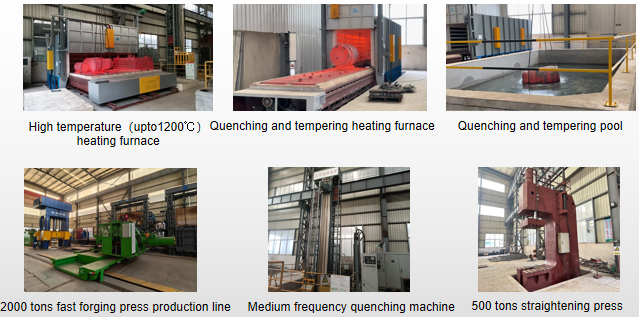
Forging&heat treatment equipment
Machining equipment

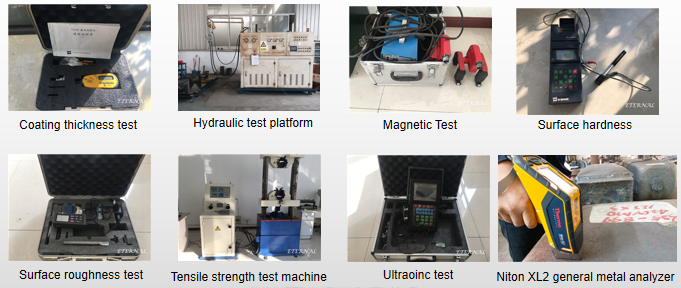
Inspection equipment
Package


