


Views: 100 Author: Site Editor Publish Time: 2026-06-15 Origin: Site


The H13 steel is a type of hot work mold die steel, suitable for die manufacturing under high-stress and high-temperature conditions. It contains high carbon, high vanadium, and appropriate amounts of chromium, molybdenum and other alloying elements, featuring excellent hardenability, wear resistance and thermal cracking resistance. These properties make it an ideal material for manufacturing plastic molds, aluminum alloy die-casting molds, hot pressing molds and precision cold stamping dies,etc.


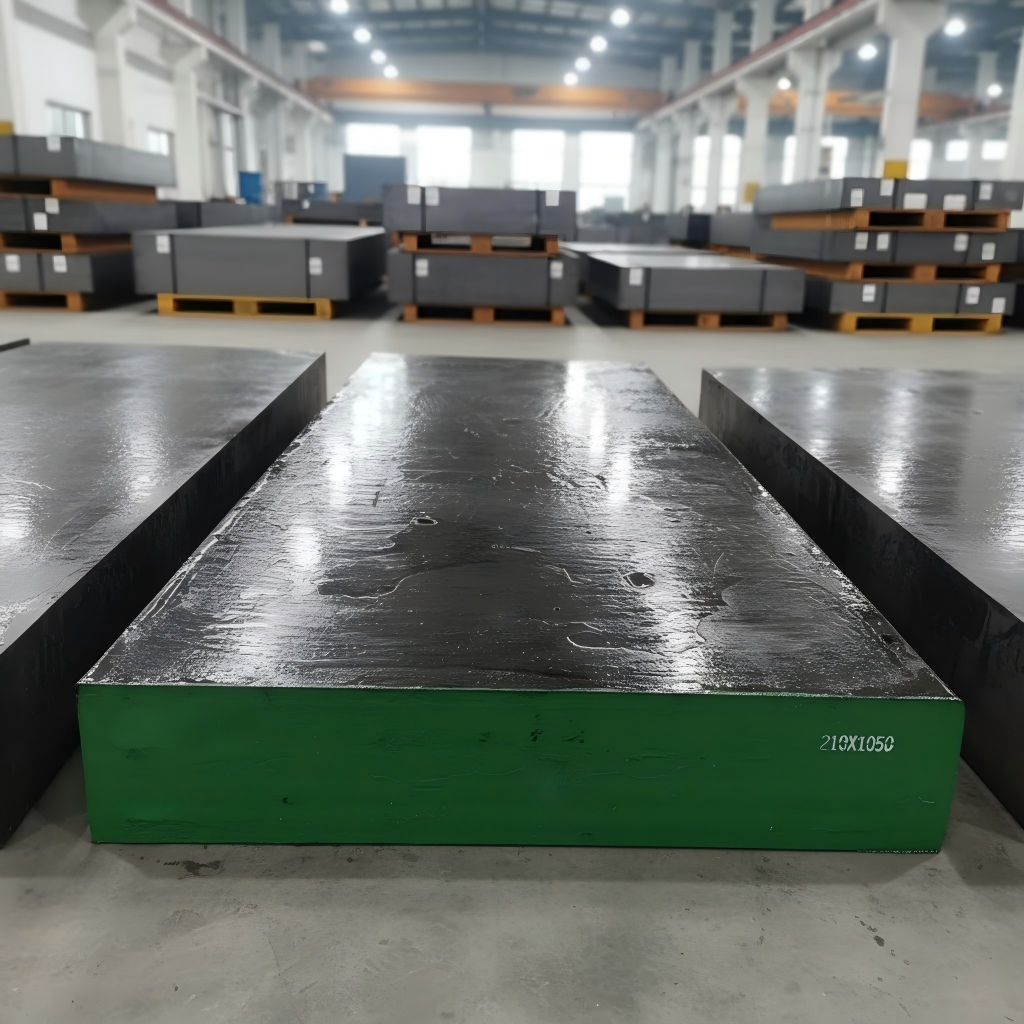
Nevertheless, large-section H13 die steel is prone to segregation and internal defects, which compromise the quality and service life of dies. To address this problem, precise control over the chemical composition and optimization of smelting, forging and heat treatment processes of H13 die steel have effectively improved microstructure uniformity and refined grains, thereby enhancing the overall performance of large-sized H13 die steel.
The carbon (C) content of H13 die steel is set at the upper limit of the standard to endow the material with high hardness and wear resistance.
The chromium (Cr) content complies with the standard to balance hardenability, corrosion resistance and thermal stability.
Manganese (Mn) content follows the standard to boost hardenability and strength while retaining good toughness.
Molybdenum (Mo) is kept at the lower standard limit to moderately improve hot strength and toughness without excessive cost increases.
Vanadium (V) is also set at the lower standard limit to refine grains, enhance strength and toughness and control production costs.
The contents of sulfur (S) and phosphorus (P) are adjusted to reduce brittleness and improve plasticity.
Gaseous elements including nitrogen (N), hydrogen (H) and oxygen (O) are strictly controlled to minimize pores and inclusions, ensuring high purity and stable performance of the steel.
Only by precisely regulating its chemical composition can ultra-large H13 die steel with superior and stable performance be produced to meet the stringent requirements of the high-end market.
The production process of H13 die steel consists of electroslag remelting, heating and forging, cooling and annealing, and final rough machining.
After annealing, the products are inspected to ensure intact microstructure and freedom from cracks and other defects. Turning is then performed with a relatively large cutting depth and feed rate: the cutting depth is 3–5 mm, the feed rate is 0.3–0.5 mm/r, and the cutting speed ranges from 100 to 150 m/min. Machined workpieces are cleaned and treated for rust prevention afterwards.
To improve the microstructure uniformity of forged H13 die steel, targeted chemical composition design and manufacturing process optimization are implemented. The forging procedure is rationally arranged; H13 die steel is produced by electroslag remelting, followed by annealing and heat treatment. Inspection on the microstructure uniformity of finished H13 dies shows that compared with conventional cast steel ingots, electroslag remelted die steel features better microstructure uniformity, higher density and significantly improved macrostructure.
Compared with conventional conventionally cast ingots, H13 die steel manufactured via electroslag remelting features higher internal density, greatly alleviated chemical segregation, and more uniform grain structure. It has drastically reduced macrostructural defects, along with comprehensively improved comprehensive mechanical properties, high-temperature resistance and wear resistance, making it suitable for manufacturing extra-large-size and high-end precision dies.
Excessive contents of nitrogen, hydrogen and oxygen will generate abundant pores inside the steel and induce non-metallic inclusions, impairing the integrity of the structural matrix. This drastically degrades the stability, toughness and wear resistance of the die steel, and easily causes cracking and premature failure of dies under high-temperature and high-pressure service conditions. Therefore, rigorous control is mandatory throughout the production process.


