


 |


| Quantity: | |
|---|---|
FORGE-R-350*L1500
ETERNAL
Working Roll of Film Calender – It is the core executive component for calendered film production, directly determining the thickness uniformity, surface finish and mechanical properties of the film. It is commonly used in production lines for plastic films and functional films such as PVC, PP and PET.
Core functions: Through the synergy of pressure, temperature and speed difference, the material undergoes plastic elongation to form a film with the target thickness, width and surface quality; it discharges internal air bubbles from the material and improves compactness.
The commonly used materials for work rolls of film calenders are mainly medium-high alloy forged steel, hot-work die steel and high-chromium steel. They are classified into three types according to operating conditions: general-purpose type, heavy-duty wear-resistant type, and high-temperature precision type.
The steel billets for forged work rolls usually undergo LF refining + vacuum degassing (VD) treatment, and even secondary refining via electroslag remelting (ESR). This effectively removes harmful impurities and gases in the steel, improves material purity and structural uniformity, and fundamentally guarantees the roll’s fatigue resistance and spalling resistance.
A sufficient forging deformation ratio (generally ≥3:1) must be maintained during forging. This fully breaks down coarse carbides in the cast structure and distributes them in a finer, more dispersed form.
After rough machining, roll blanks must undergo quenching and tempering (quenching + high‑temperature tempering) to refine grains, optimize microstructure, achieve excellent comprehensive mechanical properties, and prepare the structure for final surface hardening.
Finally, the surface of the work roll adopts medium‑frequency or dual‑frequency induction quenching to achieve extremely high hardness (HRC 58–62 and above) together with a deep hardened layer, meeting requirements for wear resistance and pressure resistance.
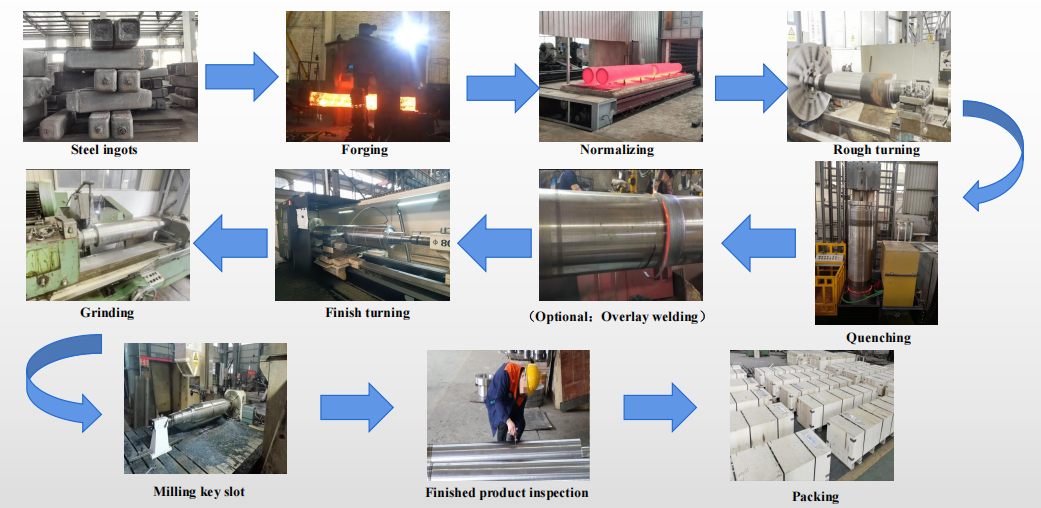
1. More than 20 years machining experience
2. Rich experience on heat treatment , including normalizing , annealing ,quenching and tempering , high frequency surface hardening etc
3. Complete production equipment from raw material to finished products
4. Strict quality control , including raw material chemical specification test, non-destructive test , size inspection , hardness test etc .
5. More than 20 years exporting experience
6. Fast delivery time


