|


| Quantity: | |
|---|---|
Forging hydraulic cylinder barrel φ1470*φ850*1445mm
ETERNAL
Operating Characteristics
Temperature Working Condition
The hot pressing temperature ranges from 180–220℃. Located close to high-temperature pressing plates, the equipment operates in a high-temperature environment with rapid temperature rise of hydraulic oil, which sets strict requirements on the high-temperature resistance of oil cylinders and sealing parts.
Operation Mode
High-frequency cyclic operation. Standard operation sequence: rapid forward mold closing → low-speed precise pressing → long-term constant temperature & constant pressure holding → slow pressure relief → rapid return stroke.
Load Working Condition
Multiple cylinders of the whole machine bear force synchronously with evenly distributed heavy loads. Subjected to alternating loads for a long time, the equipment and oil cylinders are required to have excellent performance against eccentric load, torsion and fatigue.
Application
The hydraulic cylinder barrel can be uesd in heavy-duty hydraulic cylinders specifically for Particle Board Press.
Continuous Flat Press Particleboard Press (High-end Mainstream)
It is the mainstream high-end equipment in the industry, with representative brands including Dieffenbacher and Siempelkamp from Germany, and Yalian Machinery. Adopting steel belt continuous conveying and full-process uniform pressing and heating, it features stable continuous production, uniform board density, zero thickness deviation and extremely high surface flatness. The annual production capacity of a single production line can reach 300,000 to 500,000 cubic meters, which is suitable for large-scale modern panel factories.
Multi-layer Hot Press Particleboard Press (Mid-to-low-end General Type)
Widely used by domestic small and medium-sized panel factories, mainly represented by equipments such as Sufoma and Shangren Machinery. It realizes synchronous pressing through multi-layer cavities, with low equipment investment and good flexibility, matching medium and small production capacities. Capable of mass production of conventional particleboards, it is the most popular model in the market.
Pre-press (Essential Supporting Equipment)
As the pre-matching equipment for particleboard production lines, it operates under cold pressing conditions. It rapidly compresses wood mats under low pressure to expel internal air and fix mat shapes, preventing board cracking, material leakage and deformation during hot pressing, and greatly improving hot pressing forming quality.
All core hydraulic cylinders for the full range of particleboard presses adopt integrally forged cylinder barrels made of 42CrMoA steel, perfectly suited for high-pressure and high-frequency working conditions with clear functional configurations:
Main Press Cylinder
The core power component, a large-tonnage forged plunger cylinder, undertakes high-pressure forming pressing of the entire machine to ensure consistent board thickness and density.
Pre-press Cylinder
Small-tonnage fast-moving cylinder, designed for rapid compaction in cold pre-pressing processes, featuring sensitive movement and high working efficiency.
Synchronization & Lifting Cylinder
Responsible for stable lifting and lowering of pressing plates as well as multi-cylinder synchronous adjustment, ensuring even pressure distribution across the whole board and avoiding warpage and uneven thickness.
Side Clamping Cylinder
Used to position and clamp board mats, preventing deviation and material overflow of particle mats during hot pressing, and guaranteeing high dimensional accuracy of finished boards.
Product Procedure

Core process
Forging Process
Adopt flaw-detected qualified steel ingots, uniformly heated at 1180–1250℃. Upsetting compacts internal porosity and loose structure; punching forms uniform wall thickness; hole expanding and drawing ensure accurate cylinder size with a forging ratio ≥6:1 for dense metal structure and continuous closed fiber flow. Precision shaping guarantees roundness and concentricity, and controlled cooling prevents cracking and deformation.
Heat Treatment
Integral quenching and tempering (quenching at 850–880℃ + tempering at 550–600℃) forms tempered sorbite for balanced strength and toughness with hardness HB260–300. Low-temperature stress relief after rough machining avoids deformation. Inner wall nitriding (HV≥800) or high-frequency quenching (HRC58–62) greatly improves wear resistance and fatigue resistance.
Precision Machining
Processes include rough turning, deep hole rough boring, and semi-finish boring after heat treatment. Core honing and roller burnishing achieve mirror inner wall with roughness Ra≤0.4μm. Roller burnishing realizes surface work hardening to enhance tightness and wear resistance. Finish turning of outer circle, flange and thread ensures high coaxiality and assembly accuracy.

Quality Inspection
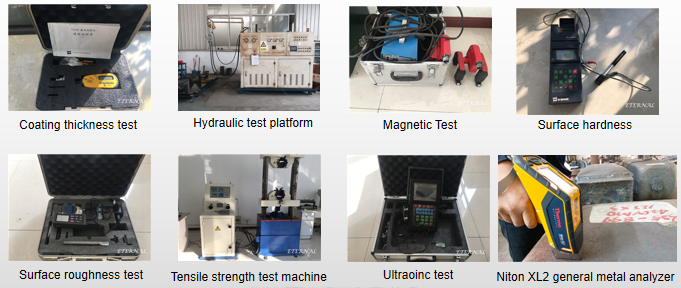
Full NDT inspection (UT Class I internal quality, MT crack-free surface), full dimensional inspection, piece-by-piece hardness test, and 1.25-times working pressure holding test for 5 minutes with no leakage and no pressure drop.
Stable pressing under high pressure and constant temperature ensures dense internal structure of boards without hollow gaps, featuring high bonding strength, excellent finished product stability and low deformation tendency.
Adopted multi-cylinder synchronous control system enables even stress on pressing plates, delivering smooth board surfaces, tiny thickness tolerance and high yield rate.
Compatible with recycling and reuse of various wood shavings, wood scraps and leftover materials, achieving high raw material utilization rate and low production cost.
Models equipped with forged oil cylinders are pressure-resistant, wear-resistant and fatigue-resistant, supporting 24-hour continuous mass production with low failure rate and long service life.
Main Facility
Machining equipment

Inspection equipment
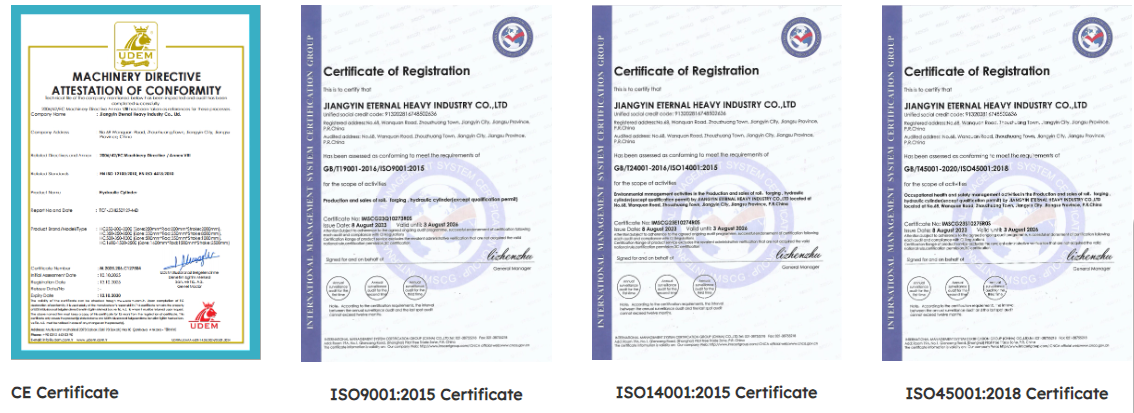
Certificate