


Views: 0 Author: Site Editor Publish Time: 2026-11-18 Origin: Site


Shifting from 4-high to 6-high configurations defines the operational threshold for modern strip production. Mill operators constantly fight to achieve tighter tolerances on harder materials. Moving toward 6-high mills directly answers the demand for higher precision in thin-gauge and high-strength material markets. You must balance product precision against maintenance overhead and capital expenditure. Evaluating material processing needs dictates how you optimize your roll configurations. Understanding the mechanical differences between 4 High vs 6 High Rolling Mills clarifies your production capabilities. A 4-high setup offers robust simplicity for standard gauges. A 6-high mill introduces complex shape control mechanisms necessary for advanced high-strength steels and non-ferrous alloys. We evaluate the specific material processing needs required to optimize your rolling operations. You need to look at the engineering fundamentals, comparative advantages, and critical component specifications to make an informed equipment decision.
Flatness Control: 6-high mills offer superior shape correction via Intermediate Roll (IMR) shifting compared to the static backup roll design of 4-high mills.
Gauge Precision: The mechanical advantage of 6-high mills is essential for minimizing roll deflection in high-strength, thin-gauge applications.
Roll Lifecycle Management: 6-high setups demand more complex maintenance schedules and high-performance customized forged rolls to ensure consistent performance.
Economic Trade-off: Determining the ROI of 6-high configurations based on reduction in off-spec scrap and downstream processing requirements.
Rolling mill architecture dictates the physical limits of strip reduction. The arrangement of rolls determines how rolling forces distribute across the mill stand. This distribution directly impacts strip shape, gauge consistency, and surface quality. When you push a mill beyond its structural limits, you generate scrap. Understanding the exact mechanical load paths within the mill housing prevents catastrophic equipment failure and ensures consistent product output.
The 4-high mill represents the industry standard for general-purpose cold rolling. The design features two small-diameter work rolls supported by two large-diameter backup rolls. The work rolls contact the metal strip directly. They perform the actual thickness reduction. The backup rolls sit above and below the work rolls. They provide the massive structural rigidity needed to prevent the work rolls from bending under extreme pressure. Without backup rolls, the work rolls would deflect instantly, creating a strip that is thick in the center and thin at the edges.
Load distribution remains straightforward in a 4-high setup. Hydraulic cylinders apply force to the backup roll chocks. The backup rolls transfer this force down to the work rolls. This configuration minimizes work roll deflection effectively for standard materials. Operators rely on work roll bending systems and thermal crowning to manage minor shape defects. You apply positive or negative bending forces to the work roll necks to alter the roll gap profile slightly. Common applications include mid-range gauge carbon steel, aluminum, and copper strip rolling. The simplicity of the 4-high design ensures high reliability and straightforward maintenance protocols. Roll shop technicians can grind standard parabolic crowns on the work rolls to match the expected thermal expansion during a rolling campaign.
However, the 4-high design hits a hard limit when processing high-strength materials. The contact arc between the work roll and the strip requires a specific amount of force to achieve plastic deformation. As material hardness increases, you need more force. This increased force causes the work rolls to flatten against the strip, expanding the contact arc and requiring even more force. This cycle eventually exceeds the mill's structural capacity or the motor's torque limits.
Advanced material processing requires more sophisticated control mechanisms. The 6-high configuration introduces Intermediate Rolls (IMRs) between the work rolls and backup rolls. This creates a third layer of control. The IMRs shift axially during the rolling process. This shifting alters the contact profile between the rolls, providing a dynamic method for controlling strip shape that a 4-high mill simply cannot match.
Dynamic crown control sets the 6-high mill apart. IMR shifting compensates for edge-drop and complex shape defects. When rolling high-strength materials, the work rolls tend to flatten and bend. Axial shifting of the IMRs changes the rigidity profile across the strip width. By moving the barrel edge of the IMR away from the strip edge, you reduce the localized pressure that causes edge drop. This eliminates quarter buckles and tight edges. High-strength alloys and advanced cold rolling processes increasingly rely on 6-high architectures. Smaller work rolls reduce the separating force required for reduction. The 6-high design supports these smaller work rolls while maintaining exceptional transverse stiffness.
The mechanical complexity of a 6-high stand requires precise alignment. The IMR chocks slide on specialized wear liners within the mill housing. Hydraulic shifting cylinders must move the rolls smoothly under heavy load. You must maintain these sliding surfaces meticulously to prevent stick-slip phenomena, which can cause sudden changes in strip shape and gauge. The addition of IMR bending systems further complicates the hydraulic circuit but provides unparalleled control over the roll gap profile.
You must distinguish 4-high and 6-high setups from cluster mills. A 20-high Sendzimir mill uses a complex backing bearing arrangement to support extremely small work rolls. Operators use cluster mills for ultra-thin stainless steel or electrical silicon steel. Planetary mills serve specialized high-reduction applications in a single pass. 4-high and 6-high mills provide higher throughput and easier maintenance compared to cluster mills. They strike a balance between production volume and shape control precision. While a 20-high mill can roll thinner material, its operating speed is generally lower, and the roll maintenance requires highly specialized equipment and training.
Selecting the right mill configuration requires analyzing your specific product mix. You must evaluate material properties, shape requirements, and production volumes. Installing a 6-high mill for standard mild steel production wastes capital. Relying on a 4-high mill for advanced high-strength steel (AHSS) guarantees high scrap rates and excessive roll wear.
Work hardening impacts roll surface integrity significantly. As metal passes through the mill, it becomes harder and more brittle. This increases the required rolling force. High rolling forces cause work roll flattening. Flattening expands the contact arc between the roll and the strip. A larger contact arc requires even more force to achieve the same reduction. This phenomenon dictates the minimum achievable gauge on any given mill.
Thin-gauge production favors the 6-high unit. 6-high mills utilize smaller diameter work rolls. Smaller rolls create a shorter contact arc. This reduces the total separating force required. The IMRs provide the necessary rigidity to prevent these smaller work rolls from deflecting. If you process AHSS, dual-phase steels, or ultra-thin gauges, the 6-high mill offers a clear mechanical advantage. 4-high mills struggle with roll flattening when pushing hard materials to thin gauges. You will experience excessive roll spalling and poor surface finish if you force a 4-high mill beyond its design parameters.
Quantifying the shape envelope reveals the limitations of 4-high mills. The shape envelope defines the range of strip profiles a mill can successfully correct. 4-high limits are quickly reached during hard-material processing. Operators rely heavily on roll grinding profiles in 4-high setups. You grind a specific crown onto the roll to compensate for expected deflection and thermal expansion. If the incoming strip profile changes, or if the mill speed varies significantly, the operator has limited tools to compensate. Work roll bending can only correct simple symmetrical defects like center wave or edge wave.
Dynamic profile adjustment defines the 6-high advantage. IMR shift patterns replace time-consuming roll changes. You can adjust the effective roll crown on the fly. This eliminates the need to stop the mill and swap rolls when processing different strip widths. The continuous variable crown (CVC) technology often integrated into 6-high mills provides precise control over complex asymmetrical defects. You grind a specific S-shaped profile onto the rolls. Shifting these rolls in opposite directions changes the quadratic crown of the roll gap continuously. This dynamic capability increases overall mill uptime and reduces scrap rates.
You must compare cycle times and mill capabilities. Reversing mills pass the strip back and forth through a single stand. Tandem mills pass the strip continuously through multiple stands. Both 4-high and 6-high configurations work in reversing and tandem setups. However, tandem 6-high mills offer unparalleled productivity for demanding materials. A typical 5-stand tandem mill might utilize 4-high stands for the first three roughing passes and 6-high stands for the final two finishing passes to guarantee perfect flatness.
Maintenance downtime factors heavily into scalability. Changing 6 rolls takes longer than changing 4 rolls. The mechanical complexity of the IMR shifting mechanism requires precise alignment. You must factor in the complexity of managing a larger roll inventory. Quick roll change (QRC) systems mitigate this downtime, but the fundamental mechanical complexity remains higher for 6-high setups. You need dedicated side-shift cars and automated porter bars to handle the intermediate rolls safely and efficiently.
Operational Parameters: 4-High vs 6-High Mills | ||
Parameter | 4-High Rolling Mill | 6-High Rolling Mill |
|---|---|---|
Roll Configuration | 2 Work Rolls, 2 Backup Rolls | 2 Work Rolls, 2 Intermediate Rolls, 2 Backup Rolls |
Work Roll Diameter | Relatively Large (Limits minimum gauge) | Relatively Small (Enables ultra-thin rolling) |
Shape Control Mechanisms | Work Roll Bending, Thermal Crown | IMR Shifting, Work Roll Bending, IMR Bending |
Reduction Capability | Moderate to High (Standard alloys) | Very High (Excellent for AHSS and hard materials) |
Maintenance Complexity | Low (Standard chock and bearing maintenance) | High (Requires shifting cylinder and wear liner upkeep) |
Primary Applications | Standard carbon steel, aluminum, copper | AHSS, thin-gauge stainless, silicon steel |
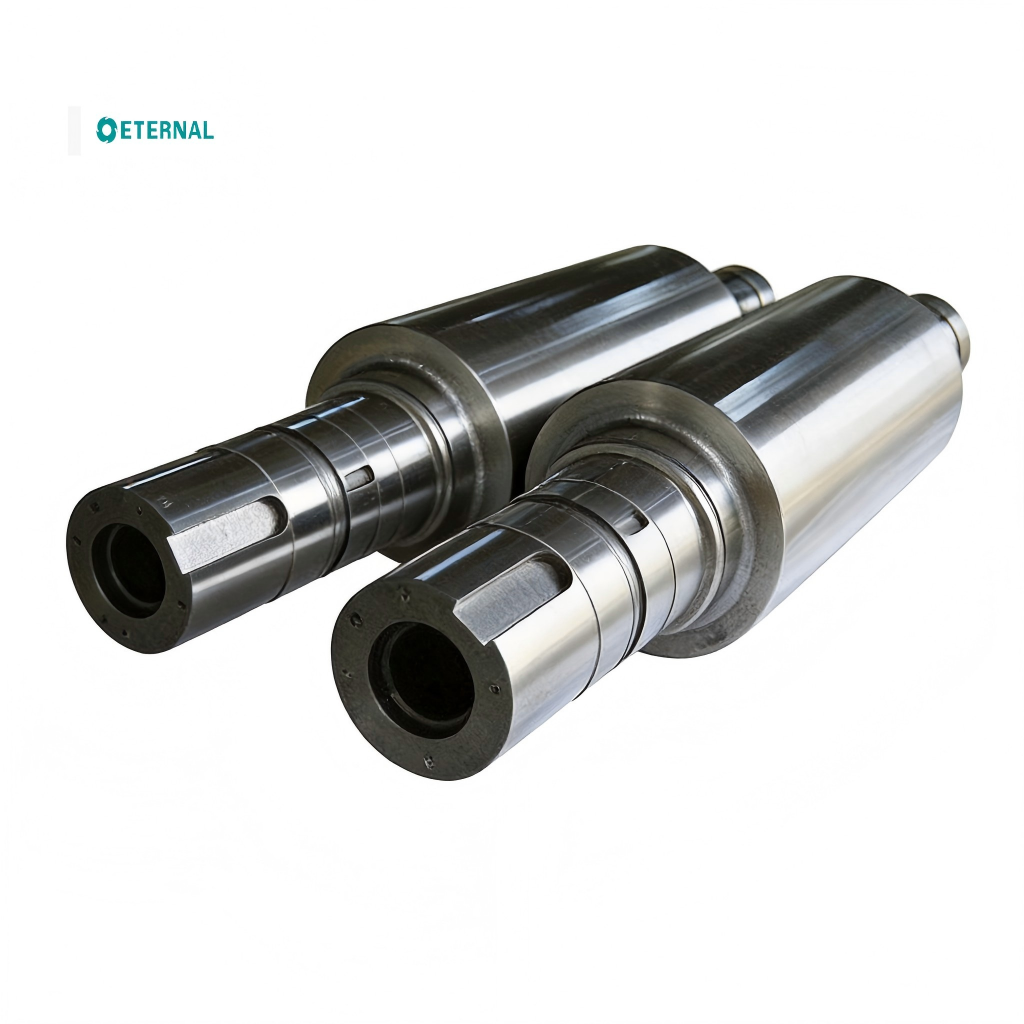
The performance of any rolling mill depends entirely on the quality of its rolls. Extreme contact pressures demand flawless metallurgical properties. You must select rolls engineered specifically for your mill configuration and product mix. Cast rolls fail rapidly in modern high-reduction cold mills. You need forged steel to withstand the cyclic fatigue and high Hertzian contact stresses.
The work roll directly dictates the surface quality of your final product. You must balance hardness and toughness carefully. High hardness prevents rapid wear and maintains the surface finish. High toughness prevents spalling and catastrophic roll breakage under heavy loads. If a work roll shatters during operation, it destroys the backup rolls and severely damages the mill housing.
A premium Cold Rolling Mill Work Roll typically utilizes 2% to 5% chromium forged steel. Advanced grades incorporate molybdenum and vanadium to refine the grain structure and form hard, wear-resistant carbides. The hardening depth must exceed the usable diameter reduction of the roll. Surface finish integrity is non-negotiable. Rolls must retain their ground roughness (Ra) over long campaigns to meet high-luster output standards. Deep cryogenic treatment during the manufacturing process stabilizes the retained austenite. This prevents dimensional changes and micro-cracking during operation. You must ensure your roll shop uses the correct grinding wheels and coolant to prevent grinding burns, which ruin the roll's surface integrity before it even enters the mill.
Backup rolls sustain the immense separating forces generated during reduction. The impact of backup roll diameter on mill stiffness cannot be overstated. A larger diameter increases the moment of inertia. This minimizes deflection across the mill width. However, larger backup rolls require larger bearings and more massive mill housings.
Fatigue resistance ensures longevity in high-pressure environments. The contact zone between the backup roll and the work roll (or IMR) experiences severe cyclic Hertzian stress. A robust Cold Rolling Mill Backup Roll requires exceptional subsurface fatigue strength. Manufacturers often use alloy steels like 70Cr3Mo. The forging process must eliminate internal voids and non-metallic inclusions. Differential heat treatment provides a hard, wear-resistant barrel surface while maintaining a tough, ductile core and neck. You must monitor backup roll wear profiles closely. Uneven wear on the backup roll transfers directly to the work roll, causing persistent shape defects in the strip.
Metallurgical consistency dictates uniform wear. Inconsistent hardness profiles cause uneven strip reduction and shape defects. You need specialized, Forged Rolling Mill Rolls to guarantee performance predictability. A roll that wears unevenly forces the operator to use excessive roll bending, which shortens the life of the roll neck bearings.
Vetting your suppliers requires strict criteria. Evaluate their precision grinding capabilities. Check their thermal stability protocols. Demand comprehensive QA certifications. A reliable Cold Rolling Mill Roll Supplier will provide ultrasonic testing reports to verify internal soundness. They should offer Customized Forged Rolls tailored to your specific mill dynamics and coolant chemistry. Standard off-the-shelf rolls rarely deliver optimal performance in demanding 6-high applications. You must work with a supplier who understands the specific contact stresses generated by IMR shifting and can adjust the forging and heat treatment processes accordingly.
Upgrading to or operating a 6-high mill introduces specific operational challenges. Proactive management of these risks ensures you achieve the expected productivity gains. Failing to adapt your maintenance and operational procedures will result in excessive downtime and damaged equipment.
Managing the increased complexity of 6-high roll assemblies requires precise coordination. You are handling six rolls instead of four. The intermediate rolls add significant weight and alignment requirements. Strategies to minimize non-productive time include investing in automated roll changing rigs. Standardize your chock assembly procedures. Maintain a highly organized roll shop to ensure the correct matched sets are always ready for deployment. Implement strict inspection routines for bearings and chocks during every roll change. A single damaged bearing seal on an IMR chock can leak water into the lubrication system, destroying the bearing within hours.
A 6-high mill relies on sophisticated software to function correctly. Integrating the software-to-hardware feedback loop is mandatory. You must automate IMR shifting and crown control based on real-time data. Install high-resolution shapemeter rolls and tensiometers. These sensors feed data to the Automatic Flatness Control (AFC) system. The AFC system calculates the required IMR shift position and roll bending forces instantly. Manual control of a 6-high mill is practically impossible for high-speed, tight-tolerance production. You must calibrate your shapemeter rolls regularly to ensure the AFC system receives accurate data.
Closing the expertise gap is critical when transitioning crews from legacy 4-high mills. Operators accustomed to 4-high setups often struggle with the multi-variable control of a 6-high mill. They must understand how IMR shifting interacts with work roll bending. Develop comprehensive training programs using mill simulators. Focus on interpreting shape feedback data. Operators must learn to trust the automation systems while retaining the ability to intervene during edge-case anomalies. They need to recognize the visual signs of roll flattening and understand when to adjust the mill speed or coolant flow to stabilize the process.
Preventing premature roll failure requires predictive wear monitoring. Standardized coolant and lubrication protocols protect the roll surface. The IMR shifting mechanism introduces sliding friction components. These require specialized lubrication schedules. Ensure coolant headers align perfectly with the dynamic roll positions. Misaligned headers cause thermal banding and localized roll wear. Implement vibration analysis on the mill stands to detect bearing degradation before it causes catastrophic roll surface damage. You must inspect the hydraulic shifting cylinders for internal leaks, as a loss of shifting pressure will cause the IMRs to drift during rolling, destroying the strip shape instantly.
Audit your current mill configuration mechanically and metallurgically to identify existing throughput bottlenecks.
Align your equipment choice strictly with your target gauge, hardness, and flatness tolerance thresholds.
Shortlist custom roll manufacturers capable of matching their forging processes to your mill's specific stress profile.
Implement upgraded shape-sensing automation before transitioning to more complex roll configurations.
A: The primary advantage is superior shape control. 6-high mills utilize Intermediate Roll (IMR) shifting. This axial movement dynamically alters the roll gap profile during operation. It allows operators to correct complex shape defects like edge wave and quarter buckle instantly, without stopping the mill to change rolls.
A: You should switch when processing advanced high-strength materials or ultra-thin gauges. If your current 4-high mill struggles with roll flattening, cannot meet tight flatness tolerances, or requires excessive passes to achieve the target gauge, a 6-high mill provides the necessary rigidity and control.
A: Yes. The extreme contact pressures and dynamic shifting in 6-high mills demand customized forged rolls. These rolls require specific metallurgical grades, precise hardening depths, and exact surface finishes to withstand cyclic fatigue and maintain uniform wear profiles across the intermediate and work rolls.
A: Roll diameter dictates the balance between reduction force and mill stiffness. Large backup rolls provide the stiffness needed to prevent bending. However, larger work rolls increase the contact arc with the strip, requiring more force to achieve reduction. 4-high mills must balance these two factors carefully.
A: Yes. A 6-high mill involves more moving parts. You must manage six rolls per stand, coordinate complex IMR shifting mechanisms, and maintain sophisticated automation sensors. The roll shop must also handle specialized grinding profiles and manage a larger inventory of matched roll sets.
A: Prioritize metallurgical expertise and QA consistency. Look for suppliers who utilize vacuum degassing for clean steel and offer deep cryogenic treatments. They must demonstrate precision grinding capabilities and the ability to engineer custom forging profiles tailored specifically to your mill's operational stresses.


