


Views: 0 Author: Site Editor Publish Time: 2026-09-29 Origin: Site


Raise boring operations demand absolute precision. Knowing exactly when to execute a raise boring roller cutter replacement prevents catastrophic mid-shaft failures. Running a compromised cutter leads to exponential downtime costs and creates severe underground safety hazards. Conversely, pulling the reamer too early wastes your consumable budget and halts production unnecessarily. The core problem lies in pinpointing the exact threshold where a cutter transitions from optimal performance to a dangerous liability. A single failed unit threatens the reaming head, machine bearings, and overall site safety. We need a technical framework for establishing data-driven replacement intervals. You must learn how to localize wear, evaluate refurbishment viability, and select reliable replacement components. This approach maximizes drilling efficiency and keeps crews safe underground.
Data-Driven Thresholds: Penetration rate drop-offs and torque spikes are primary operational indicators that precede visual failure.
Component-Level Wear: Replacement decisions must evaluate both cutting structure degradation (insert wear/breakage) and internal bearing/seal integrity independently.
Targeted Localization: Identifying and isolating specific worn or damaged cutters on the reaming head prevents cascading failures and optimizes maintenance frequency.
Refurbishment Viability: Not all wear requires total replacement; exchangeable bearings and seals can extend the life of structurally sound cutter shells, lowering overall operational expenses.
Supplier Interchangeability: Sourcing replacement cutters requires verifying strict dimensional and functional compatibility with existing OEM reaming heads (e.g., Sandvik, Atlas Copco).
Establishing a financial baseline requires comparing direct and indirect costs. The direct cost of a new raise boring roller cutter is easily quantifiable. You look at the purchase order and know the exact figure. The indirect costs of delayed replacement hit much harder. Running compromised cutters damages saddles and induces reaming head fatigue. It places immense stress on the drill string. Operators must weigh the price of a consumable part against the massive financial impact of a dropped string or a seized reaming head. When a reaming head gets stuck mid-shaft due to cutter failure, the extraction process alone can consume weeks of operational time. You have to mobilize specialized recovery equipment, halt all adjacent mining activities, and risk the safety of the recovery crew.
Operating a failed cutter triggers cascading failures across the equipment. When one cutter seizes, it stops rolling and begins dragging against the rock face. This forces adjacent cutters to overcompensate. The resulting uneven load distribution leads to rapid, asymmetrical wear across the entire reaming head. Maintenance frequency increases drastically. A single ignored bearing failure can destroy multiple healthy cutters within a single shift. We see this constantly in hard rock mining. One bad cutter turns into five bad cutters in a matter of hours. The vibration generated by a dragging cutter travels up the drill string, accelerating fatigue on the threaded connections and the machine's main thrust bearings.
Justifying replacement schedules requires a rigid Cost Per Meter (CPM) calculation. Arbitrary timelines fail in mining and tunneling. Rock hardness, abrasiveness, and compressive strength dictate cutter lifespan. By tracking the total meters drilled against the purchase and maintenance costs of the cutters, operations establish a reliable CPM. This metric proves that timely replacement saves money. You must factor in the time required to change the cutters, the cost of the replacement parts, and the expected lifespan of the new components based on geological surveys.
Cost Category | Description | Financial Impact Level | Mitigation Strategy |
|---|---|---|---|
Direct Consumable Cost | Purchase price of new roller cutters, mounting hardware, and specialized lubrication. | Low to Medium | Establish bulk supplier agreements and track CPM accurately across different rock formations. |
Unplanned Downtime | Lost production hours while extracting the reamer for emergency repairs mid-shaft. | High | Implement strict telemetry monitoring to catch failures early before they escalate. |
Equipment Damage | Fatigue on the drill string, damaged saddles, and ruined reaming heads requiring complete overhaul. | Severe | Enforce hard limits for cutter wear and bearing play during every maintenance window. |
Safety Incidents | Hazards associated with dropped strings or catastrophic mechanical failure underground. | Catastrophic | Mandate comprehensive pilot-to-reamer transition inspections and strict adherence to torque limits. |
Effective inspection methodologies allow crews to localize worn cutters quickly. The reaming head contains an array of cutters, each experiencing different load profiles. Crews must clean the head thoroughly during maintenance pauses to assess individual cutter condition. Visual inspection should systematically cover every quadrant of the reaming head. You cannot evaluate a mud-covered cutter. Wash it down with high-pressure water, rotate it by hand, and feel for internal resistance. Listen for grinding noises that indicate bearing spalling.
Tracking cutter positions predicts wear rates accurately. Gauge cutters sit on the outer edge and travel the furthest distance per revolution. They typically experience the highest wear and dictate the final hole diameter. If gauge cutters fail, the hole diameter shrinks, causing the reamer to wedge tightly into the shaft. Inner and center cutters handle different rock breaking mechanics and face distinct stress factors. Center cutters pivot tightly and face high crushing loads, while inner cutters handle the bulk of the spalling work. Documenting the exact position of raise boring cutter wear helps operators adjust thrust parameters and anticipate future replacements.
Insert failure presents several distinct visual signs. Flattening occurs when the carbide inserts lose their conical or spherical shape due to high abrasion. Once flattened, the inserts lose their ability to penetrate the rock, drastically reducing the spalling effect. "Snaking" happens when cutters track in the exact same groove repeatedly. This causes abnormal lateral wear on the inserts and places severe side-loading stress on the bearings. Carbide insert breakage usually results from excessive impact forces or encountering unexpected geological faults, such as quartz veins or fractured fault zones.
The rock formation directly dictates the observed wear pattern on the shell. Highly abrasive rock acts like sandpaper. It erodes the steel matrix around the inserts and causes them to fall out, a condition known as "washing out." Extreme hard or fractured rock causes impact damage, leading to shattered carbide. Identifying the specific wear pattern helps crews select the correct insert profile for the next drilling phase. For example, switching from a conical insert to a spherical insert might reduce breakage in highly fractured ground.
In highly abrasive environments, bearing failure often precedes shell wear. Fine rock dust and drilling fluids bypass compromised seals. Once contamination enters the bearing cavity, failure is rapid and inevitable. The abrasive particles mix with the lubricating grease, creating a grinding paste that destroys the bearing rollers and races within hours. Inspecting internal integrity is just as important as checking the cutting structure.
Crews must check for specific inspection criteria during every maintenance window. Key indicators include:
Excessive axial or radial play when manipulating the cutter by hand, indicating worn bearing races.
Metal shavings visible in the grease purge during routine lubrication, signaling internal component destruction.
Abnormal heat buildup immediately after halting rotation, caused by extreme internal friction.
Visible seal extrusion or tearing around the journal hub, allowing contaminants free entry.
Complete seizure where the cutter refuses to rotate under manual force, requiring immediate removal.
Visual failure is often preceded by operational telemetry changes. Operators at the console must monitor thrust requirements continuously. If the machine requires significantly more thrust to maintain the same penetration rate, the cutting structures are likely blunted. This drop in efficiency indicates that the cutters are crushing the rock rather than effectively spalling it. Crushing requires exponentially more energy and generates excessive fine dust, which further accelerates wear on the remaining components.
Erratic torque readings provide another vital warning sign. Smooth, consistent torque indicates healthy rolling action across the rock face. Sudden torque spikes suggest that one or more cutters are seizing and dragging. When a cutter drags, it acts as a brake against the rotation of the reaming head. Monitoring these telemetry trends allows operators to schedule inspections before catastrophic mechanical failure occurs. Advanced rigs utilize automated data logging to track these trends over the entire length of the shaft, providing a clear picture of cutter degradation.
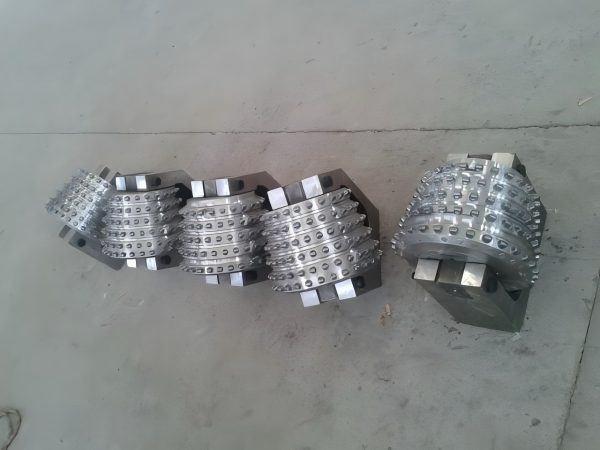
Selecting the right material extends replacement intervals and optimizes drilling efficiency. A standard tungsten carbide roller cutter offers exceptional hardness. It resists abrasion in homogenous, highly abrasive rock formations like quartzite or solid granite. The high hardness prevents the inserts from flattening prematurely. However, extreme hardness often comes at the cost of toughness. This makes standard carbide susceptible to chipping under heavy impact, especially when the reamer transitions between different rock layers.
A forged carbide roller cutter provides an alternative for challenging geologies. The forging process aligns the grain structure of the steel matrix and enhances the material's overall toughness and impact resistance. This makes it ideal for fractured, faulted, or highly variable rock formations where shock loading is common. When the reamer hits a void or a fractured zone, the forged cutter absorbs the impact without shattering the carbide inserts. Operators must evaluate the trade-off between extreme hardness and impact toughness when specifying replacement materials.
Material Type | Primary Advantage | Ideal Rock Condition | Wear Characteristic |
|---|---|---|---|
Standard Tungsten Carbide | Extreme hardness and abrasion resistance | Highly abrasive, homogenous rock | Resists flattening but prone to chipping under heavy impact |
Forged Carbide | Superior toughness and impact resistance | Fractured, faulted, or variable formations | Absorbs shock well, reducing catastrophic insert breakage |
The arrangement of inserts heavily influences the wear rate and the overall efficiency of the rock breaking process. Kerf cutters feature inserts aligned in distinct, continuous rings. They cut concentric grooves into the rock face, causing the ridges between the grooves to spall off in large chips. This highly efficient cutting action is perfect for hard, uniform rock. It maximizes the penetration rate and minimizes the specific energy required to excavate the shaft. However, kerf cutters can lead to tracking issues in softer formations, where the cutters fall into existing grooves and fail to break new rock.
Random cutting structures place inserts irregularly across the cutter shell. This prevents the cutter from tracking in existing grooves. Random placement ensures continuous rock engagement in fractured or variable ground. The irregular pattern forces the inserts to constantly attack new areas of the rock face, maintaining a steady penetration rate even in difficult conditions. Selecting between kerf and random designs dictates specific replacement intervals based on the geological profile and extreme rock hardness.
The pilot-to-reamer transition is the most demanding maintenance window in raise boring. Once the pilot hole connects to the lower access level, the pilot bit is removed. Before the raise boring reamer is attached and upward reaming begins, crews must perform a comprehensive cutter audit. This is the last opportunity to inspect the equipment before it enters the shaft for the main reaming phase.
This audit ensures no compromised cutters begin the upward phase. Replacing a cutter mid-shaft is incredibly dangerous and time-consuming. It requires miners to work under an unsupported span or necessitates pulling the entire reamer back down to the access level. Proper raise boring tool maintenance at this exact transition point mitigates the risk of cascading failures. Every cutter must be manually rotated, greased, and visually inspected. Torque wrenches must be used to verify that all saddle mounting bolts are tightened to the manufacturer's exact specifications.
Not all worn cutters require total replacement. If the cutter shell and saddle mounts maintain structural integrity, the unit can often be rebuilt. Refurbishment focuses on replacing the internal wear components while salvaging the heavy steel exterior. This approach significantly reduces the consumable budget for long-term projects.
The rebuild process involves extracting the old journal, bearings, and seals using specialized hydraulic presses. Technicians clean the internal cavity, inspect the bearing races for scoring, and press in new, exchangeable bearings and high-temperature seals. They repack the cavity with specialized heavy-duty grease designed to withstand extreme underground temperatures. This restores operating efficiency at a fraction of the cost of a brand-new unit. However, the shell must have sufficient carbide insert life remaining to justify the rebuild expense. If the inserts are already flattened or the matrix is heavily eroded, rebuilding the internal components is a waste of resources.
Maintaining a safe work environment requires strict adherence to scrapping limits. Certain types of damage are non-negotiable and mandate immediate total replacement. Attempting to run or rebuild a severely compromised cutter risks catastrophic failure, which can leave metal debris in the shaft and destroy subsequent replacement cutters.
Hard limits for scrapping include:
Severe shell cracking that compromises structural integrity, often visible radiating from the insert holes.
Washed-out insert holes resulting in a loss of interference fit for the carbide, causing inserts to fall out during operation.
Irreparable hub or journal damage that prevents proper bearing seating, leading to immediate seal failure upon reassembly.
Excessive matrix erosion that exposes the base of the carbide inserts, removing the necessary support structure.
Deformation of the saddle mounting points, which prevents the cutter from aligning correctly on the reaming head.
Integrating aftermarket cutters into existing OEM fleets requires strict technical verification. A reliable raise boring cutter supplier must guarantee exact dimensional matching. The saddle mounting dimensions, bolt patterns, and overall cutting profiles must align perfectly with the existing reaming head. You cannot force a mismatched cutter onto a precision-engineered reamer.
Failing to verify compatibility leads to mounting difficulties and uneven cutting profiles. If a replacement cutter sits even a few millimeters higher or lower than the adjacent units, it will bear a disproportionate amount of the thrust load, leading to immediate premature failure. Interchangeability with major brands like Sandvik and Atlas Copco ensures that operators are not locked into single-source procurement. Exact dimensional matching guarantees seamless integration and maintains the engineered load distribution of the reaming head.
Evaluating a supplier requires looking beyond the initial purchase price. Metallurgical consistency is paramount. The steel alloy used for the shell and the grade of tungsten carbide must remain consistent across every batch. A single batch of poorly heat-treated cutters can derail an entire drilling schedule. Bearing origin is equally important; suppliers should utilize SKF, Timken, or equivalent high-grade bearings to ensure longevity under extreme loads.
Supply chain reliability is mandatory for remote mining and tunneling sites. Delays in consumable delivery halt entire projects, costing tens of thousands of dollars per day in lost production. Mitigate implementation risks by requesting trial runs and metallurgical certifications. Testing a small batch ensures consistent performance over time before committing to fleet-wide replacement contracts. You need a supplier who understands the logistics of delivering heavy steel components to isolated underground operations on strict deadlines.
Conduct a comprehensive wear audit on all currently active reaming heads before initiating the next drilling phase.
Implement a strict telemetry monitoring protocol at the operator console to track sudden torque spikes and penetration rate drop-offs.
Contact a technical specialist to evaluate your specific rock conditions and match them with the optimal carbide insert profile.
Establish a clear Cost Per Meter (CPM) baseline using historical drilling data to justify future refurbishment or replacement decisions.
A: Lifespan varies entirely based on meters drilled, rock compressive strength, and extreme rock hardness. It is not measured in time. In highly abrasive formations, a cutter may last only a few hundred meters. In softer rock, it can exceed thousands of meters. Continuous monitoring is essential.
A: Yes. Bearings and seals are exchangeable for cutter refurbishment. This is only viable if the cutter shell, saddle mounts, and carbide inserts remain within acceptable wear tolerances. Severe shell cracking or washed-out insert holes mandate total replacement.
A: Premature failure typically stems from improper thrust parameters or incorrect insert selection for the specific rock type. Seal failure is another major cause. When seals fail, drilling fluid and debris enter the assembly, leading to rapid bearing seizure.
A: You must verify exact dimensional matching. Check the saddle dimensions, mounting bolt patterns, and overall cutter profile. Strict adherence to these specifications ensures seamless interchangeability with major OEM equipment brands like Sandvik and Atlas Copco.
A: Kerf cutters feature inserts arranged in distinct rings, ideal for cutting grooves and spalling hard, homogenous rock. Random cutters have inserts placed irregularly across the shell. This random arrangement excels in fractured or variable formations by preventing tracking in existing grooves.
A: Sudden torque spikes strongly indicate a seized or severely worn roller cutter. The failed cutter drags against the rock face rather than rolling. This creates massive friction and requires immediate inspection and maintenance to prevent damage to the entire reaming head.


