|


| Quantity: | |
|---|---|
FORGE-TUBE
ETERNAL
F51 stainless steel, also known as UNS S31803, is a duplex stainless steel with a microstructure consisting of two phases: austenite and ferrite. It has excellent corrosion resistance, strong resistance to chloride and acidic environments, and high strength.
F51 and Other Similar Duplex Stainless Steel Material Steel Grade
GB/T | UNS | AISI/ASTM | ID | Trademark | JIS | W.Nr | |
Duplex Stainless Steel | 022Cr22Ni5Mo3N | S31803 | F51 | AL2205 | SUS32953L | 1.4462 | |
OCr26Ni5Mo2 | S32900 | 329 | SUS32951 | 1.446 | |||
S32950 | F52 | ||||||
022Cr25Ni7Mo4N | S32750 | 2507 | F53 | 1.441 | |||
S39274 | F54 | ||||||
022Cr25Ni7Mo4WCuN | S32760 | F55 | 1.4501 | ||||
022Cr23Ni5Mo3N | S32205 | 2205 | F60 | ||||
03Cr25Ni6Mo#Cu2N | S32550 | 255 | F61 | SUS32954L | 1.4507 |
F51 Chemical Compisition
| C | Si | Mn | Cr | Mo | N | Ni | P | S |
| ≤0.03% | ≤1% | ≤2% | 21-23% | 2.5-3.5% | 0.08-0.2% | 4.5-6.5% | ≤0.03% | ≤0.02% |
F51 Heat Treatment
As a duplex stainless steel, the core goal of heat treatment for F51 stainless steel is to obtain a balanced austenite ferrite duplex structure, while eliminating harmful phases, improving corrosion resistance and mechanical properties.
Solution treatment (core process)
Temperature range: 1020-1100 ℃, commonly used temperature is 1050-1080 ℃. Low temperature can lead to insufficient precipitation of austenite, high proportion of ferrite, and reduced toughness and corrosion resistance; If the temperature is too high, it will cause coarse grains and may lead to a decrease in ferrite content and strength.
Insulation time: determined according to the thickness of the workpiece, generally 1-2 hours/25mm thickness, to ensure sufficient and uniform organization.
Cooling method: Rapid cooling must be used, water cooling is preferred, and air cooling can be used for workpieces with smaller thickness. Rapid cooling can suppress the precipitation of harmful phases such as carbides and σ at grain boundaries, avoiding a decrease in corrosion resistance and toughness.
Post treatment effect: Obtain a balanced dual phase structure of approximately 40% -60% austenite and 40% -60% ferrite, at which point the material's resistance to pitting corrosion, stress corrosion cracking, and strength and toughness reach their optimal state.
Stress relief annealing
Applicable scenarios: Used for welding parts or workpieces after cold processing, with the aim of eliminating internal stress, preventing subsequent deformation or cracking.
Temperature range: 550-650 ℃, holding time of 2-4 hours, cooling method can be air cooling.
F51 Mechanical Property
Intensity index
Yield strength(Rp0.2): ≥ 450 MPa at room temperature (there may be slight differences in the shape of forgings, plates, etc., and it can reach 670 MPa under some working conditions).
Tensile strength(Rm): ≥ 620 MPa at room temperature, up to a maximum of 875 MPa.
Plasticity and toughness indicators
Elongation rate(A5): ≥ 25%, with good ductility and excellent cold forming performance.
Shrinkage rate of section(Z): ≥ 45%, able to withstand significant plastic deformation before fracture.
Impact toughness(Akv): ≥ 100 J at room temperature and can maintain high toughness even in low temperature environments (such as -40 ℃), with strong impact resistance.
Hardness index
Brinell hardness (HB): ≤ 290.
Rockwell hardness (HRB): ≤ 29.
Moderate hardness, easy to perform cutting, welding and other processing operations.
F51 Stainless Steel Condenser Tube Sheet Application
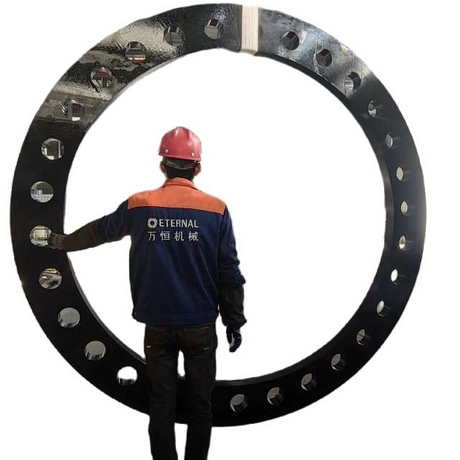
The stainless steel tube sheet of F51 condenser is mainly used in industrial scenarios with strong corrosion, high pressure, high humidity, or complex media due to its high strength, excellent corrosion resistance, good weldability, and cost-effectiveness.
In the petrochemical industry, it is used to manufacture equipment such as condensers and heat exchangers, which can withstand corrosion from oil, gas, and chemical media;
Specific applications: tower top condensers in refineries, reaction material condensers in chemical plants, and tube sheets in acid-base medium heat exchange systems.
In marine environments, it can be used for seawater desalination equipment, ship condensers, etc., to resist the erosion of seawater.
Specific applications: Condenser tube sheets for seawater desalination devices, condensers for central cooling systems of ships, and condensers for cooling media on offshore platforms.
In some scenarios of thermal power, nuclear power, and new energy generation in the power industry, the condenser medium is corrosive or operates under harsh conditions, and the F51 tube sheet can meet the demand.
Specific applications: condensers for flue gas desulfurization systems in thermal power plants, condensers for auxiliary cooling systems in nuclear power plants, and high-temperature medium condensers for biomass power generation.
The cooling medium in the metallurgical and papermaking industries often contains acidic substances, and the black liquor, white water, and other media in the papermaking industry are highly corrosive. The F51 tube sheet can adapt to such harsh working conditions.
Specific applications: Smelting flue gas condenser in metallurgical plants, black liquor concentration condenser in paper mills.