


Views: 0 Author: Site Editor Publish Time: 2026-09-02 Origin: Site


Precision in metal forming depends entirely on the structural integrity and dimensional stability of the rolling mill rolls. Misaligning the mechanical properties of rolls with their specific function within the mill stand leads to premature wear, strip profile defects like edge drop or center buckle, catastrophic roll failure, and excessive unplanned downtime. Evaluating the exact metallurgical and mechanical distinctions between a work roll vs backup roll is necessary for procurement engineers aiming to optimize mill performance and select the right manufacturing partner. We will break down the technical differences, material selection criteria, and mill configuration requirements to help you specify the correct roll for your application. Understanding these variables prevents costly production halts and ensures your final rolled products meet strict gauge tolerances.
Functional Distinction: Work rolls directly deform the metal strip and dictate surface finish, while backup rolls provide structural rigidity to prevent work roll deflection under extreme rolling loads.
Mill Configuration Dependency: While Two-High and Three-High mills rely solely on work rolls, modern high-reduction mills (Four-High, Six-High) necessitate backup rolls to manage intense separating forces.
Metallurgical Trade-offs: Work rolls require extreme surface hardness (often utilizing cast iron or high-speed steel); backup rolls require high core toughness and resistance to subsurface contact fatigue, making forged steel the standard.
Application Specificity: A cold rolling work roll demands different alloying elements and heat treatments compared to hot rolling rolls due to the absence of thermal shock but higher requirements for surface precision.
Sourcing Criteria: Selecting a rolling mill roll manufacturer requires evaluating their in-house forging, deep-hardening heat treatment capabilities, and non-destructive testing (NDT) protocols.
Understanding roll mechanics requires looking at how forces transfer through the mill stand. Each roll type handles a specific type of mechanical stress and performs a distinct job in the reduction process.
The rolling mill work roll acts as the primary point of contact with the workpiece. Whether processing steel strip, aluminum sheet, or heavy plate, these rolls execute the actual physical deformation. They are directly responsible for achieving the target thickness, managing the deformation degree, and ensuring strict processing accuracy.
Because they physically crush the metal, work rolls endure intense friction and localized pressure. The surface must resist rapid abrasive wear while maintaining a precise geometric profile. In hot rolling applications, these rolls also face severe thermal cycling as they contact red-hot metal and then rapidly cool via water sprays. This continuous heating and cooling cycle demands exceptional resistance to thermal fatigue and fire cracking.
Specific operational duties include:
Transferring motor torque directly to the metal strip to drive the rolling process.
Imparting the final surface texture to the sheet metal.
Maintaining a consistent roll gap to guarantee uniform gauge thickness.
Resisting surface degradation from scale, metal debris, and high-pressure coolant.
You will find backup rolls positioned directly above the top work roll and below the bottom work roll in four-high or six-high configurations. Their primary job is structural support. When metal passes through the work rolls, it generates massive separating forces that push the work rolls apart.
Without support, the relatively small-diameter work rolls would bend outward in the center. This bending causes the rolled strip to become thicker in the middle and thinner at the edges—a defect known as poor strip profile or crown. Backup rolls absorb and distribute these massive separating forces. They prevent the smaller work rolls from deflecting, ensuring uniform strip thickness across the entire width of the material.
Backup rolls handle the following structural tasks:
Absorbing vertical separating forces exceeding thousands of tons.
Providing a rigid backing to maintain the work roll's horizontal alignment.
Transferring the load from the hydraulic screw-down cylinders evenly across the work roll barrel.
Advanced mill configurations, such as six-high and cluster mills, introduce intermediate rolls. These sit between the work roll and the backup roll. They bridge the dimensional gap and distribute forces more evenly.
More importantly, intermediate rolls often feature axial shifting capabilities. Operators can slide these rolls laterally during the rolling process. This lateral movement alters the contact pressure distribution across the strip width, providing advanced shape control to correct complex flatness defects like quarter buckle or wavy edges.
The physical and mechanical requirements for these two roll types diverge significantly. Engineers must design them to survive completely different stress environments.
Work rolls face a hostile surface environment. They experience high abrasive wear from continuous sliding contact with the metal strip. The drive spindles connect directly to the work roll necks in many mill setups, subjecting them to severe torsional stress. Thermal fatigue remains a constant threat, particularly in hot mills where surface temperatures fluctuate wildly within a single rotation.
Backup rolls face deep, internal structural stresses. They endure massive compressive loads transferred from the work rolls. The roll necks experience extreme bending moments as the hydraulic cylinders or screw-downs apply downward force. Furthermore, the interface where the backup roll meets the work roll generates intense Hertzian contact stress. This concentrated pressure pushes deep beneath the surface of the backup roll barrel, threatening to cause internal sheer failure.
Diameter ratios highlight the most obvious visual difference. Backup rolls are significantly larger in diameter than work rolls. This massive size maximizes their moment of inertia, providing the extreme stiffness required to resist bending. The large surface area also helps distribute the rolling pressure over a wider contact zone.
Crown profiles also differ. Roll grinders apply a specific initial camber (or crown) to rolls to compensate for expected deflection and thermal expansion during operation. Work rolls and backup rolls receive different crown profiles because they bend and heat up at different rates. Matching these profiles perfectly is essential for maintaining a flat strip shape.
Surface finish requirements dictate different machining approaches. Work rolls require precise grinding and specialized texturing. Depending on the final product requirements, manufacturers might apply Electrical Discharge Texturing (EDT) or shot blasting to the work roll surface. The strip perfectly mirrors whatever texture exists on the work roll.
Backup rolls do not contact the strip, so they do not need specialized surface textures. However, they require extreme geometric accuracy. The cylindricity and concentricity of a backup roll must be flawless. Any slight ovality or surface irregularity on the backup roll will cause vibration. This vibration transfers directly to the work roll, printing visible chatter marks onto the finished metal strip.
Technical Dimension | Work Roll | Backup Roll |
|---|---|---|
Primary Function | Direct metal deformation and surface finish control | Structural support and force distribution |
Dominant Stress Type | Abrasive wear, thermal fatigue, torsional stress | Compressive loads, bending moments, Hertzian stress |
Diameter Size | Smaller (optimized for bite angle and reduction) | Massive (optimized for maximum stiffness) |
Surface Requirement | Precise texture (EDT, ground) transferred to strip | Perfect cylindricity to prevent mill chatter |
Crown Profile | Aggressive camber to counteract thermal expansion | Subtle camber to counteract mechanical deflection |
Drive Mechanism | Directly driven by mill spindles | Typically friction-driven by the work rolls |
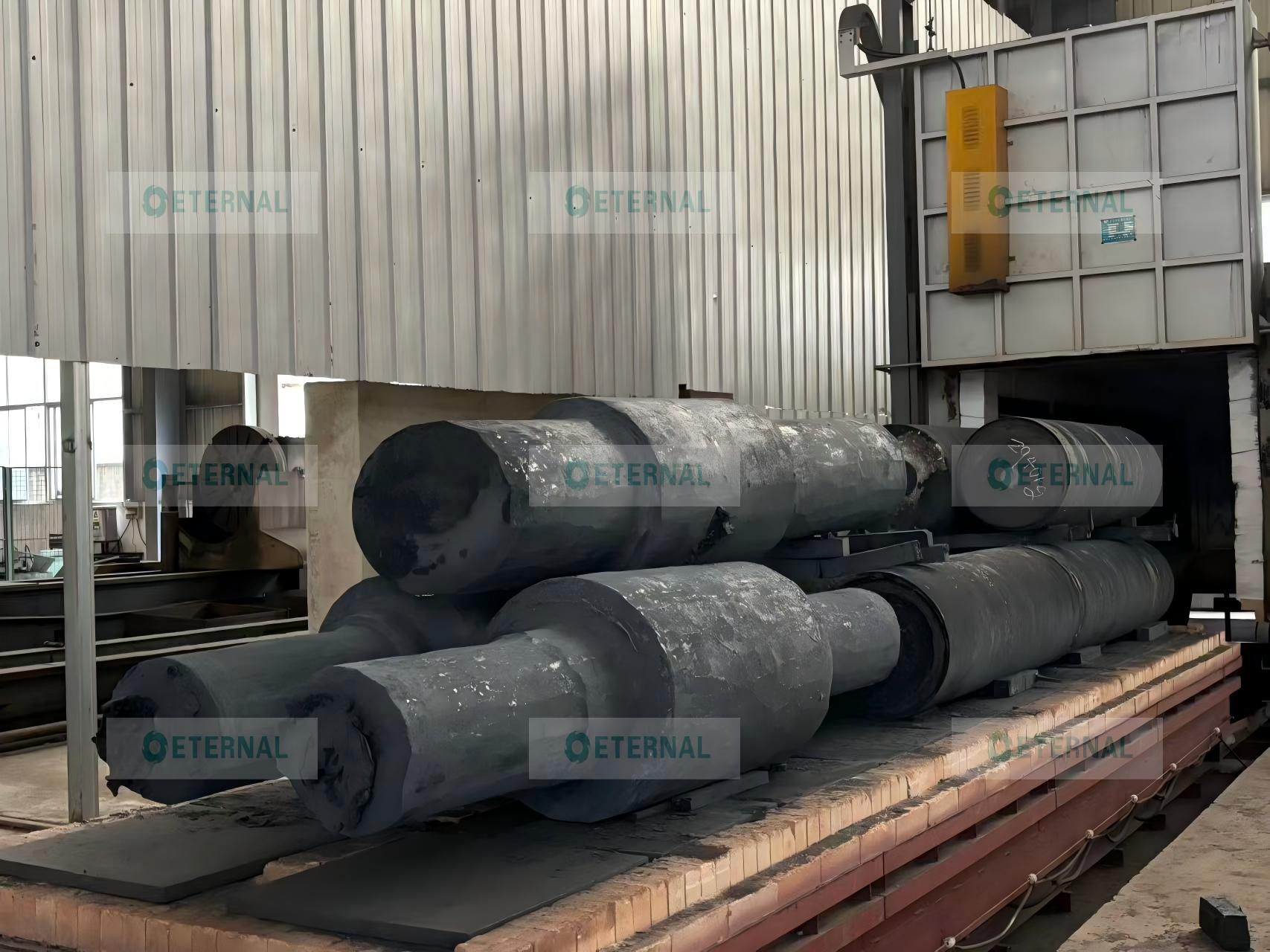
Metallurgists formulate distinct chemical compositions and heat treatment protocols based on whether a roll will deform metal or support the mill structure.
A cold rolling work roll operates at room temperature but faces extreme friction. The primary requirement is exceptional surface hardness, typically ranging from 90 to 95 Shore C. This hardness prevents rapid wear and maintains the tight dimensional tolerances required for thin-gauge cold-rolled strip.
Manufacturers typically forge these rolls from highly alloyed steel containing 2% to 5% Chromium. Advanced mills increasingly utilize High-Speed Steel (HSS) or semi-high-speed steel to extend campaign lengths. Achieving the necessary hardness requires precise heat treatment. Facilities use induction hardening or progressive dual-frequency hardening to transform the surface microstructure into hard martensite packed with fine, wear-resistant carbides. The core remains relatively ductile to absorb operational shocks.
Hot rolling environments change the metallurgical priorities entirely. Thermal shock resistance and high-temperature wear resistance take precedence over absolute surface hardness. If a cold mill roll were used in a hot mill, the extreme temperature fluctuations would cause it to shatter.
Cast iron rolls dominate this application. High-Chrome Cast Iron and Nodular (Ductile) Cast Iron provide the necessary graphite structure to resist fire cracking. The casting process allows metallurgists to create a hard, wear-resistant outer shell while maintaining a softer, shock-absorbing core. Surface hardness remains important, but the ability to survive thermal cycling dictates the material choice.
A forged steel backup roll must survive relentless compressive forces. The primary engineering requirements are spalling resistance, high yield strength, and exceptional core toughness. If a backup roll breaks, it causes catastrophic mill damage and weeks of downtime.
Manufacturers rely on medium-carbon alloy steels, specifically Cr-Mo-V alloys like 3Cr-Mo-V or 5Cr-Mo-V. These elements provide deep hardenability and high tensile strength. The manufacturing process involves differential heat treatment. The goal is to achieve a moderately hard, wear-resistant barrel surface (typically 55-65 Shore C) to resist Hertzian contact stress. Simultaneously, the core and the roll necks must remain highly ductile to survive the massive bending moments applied by the mill housing.
Roll Type | Target Surface Hardness | Primary Material | Heat Treatment Method |
|---|---|---|---|
Cold Work Roll | 90 - 95 Shore C | 2-5% Cr Forged Steel, HSS | Induction Hardening |
Hot Work Roll | 70 - 85 Shore C | High-Chrome Cast Iron, Nodular Iron | Centrifugal Casting & Tempering |
Backup Roll | 55 - 65 Shore C | Cr-Mo-V Forged Alloy Steel | Differential Heat Treatment |
The design of the rolling mill stand dictates the exact specifications required for the rolls. Different configurations apply forces in entirely different ways.
Two-High (Pull-Over or Reversing) and Three-High mills represent older or more specialized designs. They utilize large-diameter work rolls without any backup support. Because the work rolls must provide their own structural rigidity, they are massive. However, this large diameter creates a long contact arc with the metal, increasing the required rolling force. These mills struggle to roll very thin gauges due to roll flattening and inevitable bending.
Four-High, Six-High, and Cluster (Sendzimir) mills solve this problem. They utilize much smaller work rolls. A smaller work roll bites into the metal more efficiently, reducing the required separating force and allowing for extreme gauge reduction. However, these small rolls possess very little structural stiffness. They absolutely necessitate massive backup rolls to counteract deflection and keep the strip flat.
The thermal environment dictates the operational focus. A cold rolling mill roll focuses on managing extreme compressive yield strength. Cold metal resists deformation aggressively. The rolls must crush the grain structure while retaining a flawless, mirror-like surface finish. Any microscopic defect on a cold mill roll will ruin the final product.
Hot rolling applications focus on managing extreme temperature variations. The rolls must resist rapid oxidation and scale buildup. Fire-crack prevention drives the maintenance schedule. The rolls must maintain their profile even as they expand and contract continuously during the rolling campaign.
Rolls fail when operational stresses exceed metallurgical limits. Understanding these failure modes allows operators to adjust maintenance schedules and prevent catastrophic breakdowns.
Work rolls suffer from surface-level degradation. In hot rolling, thermal cracking and banding are the most common issues. The continuous heating and cooling create microscopic network cracks. If left unchecked, these cracks link together, causing chunks of the roll surface to break away (banding).
Surface spalling occurs in both hot and cold mills. This happens due to localized overload, often caused by strip cobbles (where the metal folds over on itself and jams the mill). Abrasive wear is a constant reality. Over time, the roll loses its engineered crown profile, compromising processing accuracy and forcing a roll change.
Backup roll failures tend to be deep and structural. Subsurface fatigue spalling represents the greatest threat. The intense Hertzian stress between the work roll and backup roll creates maximum shear stress slightly below the barrel surface. If the forged steel contains non-metallic inclusions (impurities), these act as stress concentrators. Micro-cracks form internally and propagate outward, eventually causing massive chunks of steel to blow off the roll face.
Roll neck breakage occurs due to severe torsional overload or improper bearing fitment. Environmental degradation also destroys backup rolls. The ingress of industrial dust, metal chips, heavy scale, and degraded rolling oil can ruin the roll barrel surface or destroy the expensive neck bearings.
Roll necks rely on precision bearings housed within heavy steel chocks. If the clearance between the roll neck and the bearing inner race is incorrect, the roll will experience excessive runout. This runout translates directly into gauge variations in the rolled strip. Furthermore, misaligned chocks create uneven loading across the roll barrel. One side of the roll will bear a disproportionate amount of the separating force, leading to accelerated wear and premature fatigue failure on that specific side. Maintenance teams must calibrate chock alignment during every roll change.
Preventing roll failure requires aggressive, data-driven maintenance. Relying solely on visual inspection guarantees failure. Mills must establish strict roll grinding schedules based on tonnage rolled, kilometers of strip processed, and deformation degree.
Implementing non-destructive testing during regrinding is non-negotiable. Operators must use eddy current testing to find surface anomalies and ultrasonic testing (UT) to detect deep subsurface micro-cracks before they propagate. Furthermore, maintaining strict fluid filtration systems protects backup rolls from metal chips and oil contamination, extending their operational life.
Standard maintenance procedures include:
Tracking total tonnage processed per roll campaign to establish baseline wear rates.
Executing ultrasonic testing during every scheduled regrind to monitor internal integrity.
Monitoring bearing temperatures via sensors to detect early signs of neck friction.
Filtering rolling oil continuously to remove abrasive metal fines and scale.
Procuring high-performance rolls requires looking past the dimensional drawings and evaluating the supplier's metallurgical capabilities.
The lifespan of a backup roll depends entirely on steel purity. When evaluating a supplier for a custom forged rolling mill roll, you must verify their melting practices. Vacuum degassing and electroslag remelting (ESR) are critical processes. They remove trapped gases and non-metallic inclusions that cause subsurface spalling.
The manufacturing sequence for a high-quality backup roll involves multiple critical stages. It begins with ingot casting, where the steel is poured under vacuum to prevent hydrogen flaking. The ingot then undergoes open-die forging. The forging press applies thousands of tons of force to upset and draw out the steel. This mechanical working breaks up the coarse as-cast grain structure and aligns the grain flow with the roll's geometry. A higher forging reduction ratio directly correlates to better mechanical properties in the finished roll. After forging, the roll undergoes preliminary machining and a complex series of normalizing and tempering cycles to relieve internal stresses before final hardening.
A reputable rolling mill roll manufacturer provides comprehensive documentation for every roll. You should demand chemical composition analysis reports, mechanical property testing results showing the hardness gradient from surface to core, and full NDT certification (UT and magnetic particle inspection).
Evaluate their lead times and engineering support. The best manufacturers do not just build to print. They possess the engineering capability to reverse-engineer failed rolls or optimize existing roll specifications based on your specific mill data, including operating temperatures, rolling pressures, and line speeds.
Audit your current roll failure data to identify recurring spalling or wear patterns across your mill stands.
Define the exact hardness depth and core toughness requirements for your specific mill configuration before issuing a purchase order.
Implement strict ultrasonic and eddy current testing protocols during your roll grinding cycles to catch subsurface fatigue early.
Consult with a specialized roll manufacturer to quote custom-engineered alloys that match your operational stresses.
A: Cold rolling work rolls typically require a surface hardness between 90 and 95 Shore C. This extreme hardness is necessary to resist abrasive wear, maintain tight dimensional tolerances, and impart a flawless surface finish to the cold-rolled strip.
A: Backup rolls must endure massive bending moments and compressive loads. Forged steel provides the high yield strength and exceptional core toughness required to prevent catastrophic breakage. Cast iron lacks the necessary ductility and would snap under the extreme structural stresses of a backup roll application.
A: A larger backup roll diameter increases the roll's moment of inertia, providing greater structural stiffness. This stiffness prevents the work rolls from bending under high separating forces, ensuring uniform thickness across the width of the rolled strip.
A: Spalling usually originates from subsurface fatigue. Intense Hertzian contact stress creates shear forces deep below the surface. If the steel contains non-metallic inclusions, micro-cracks form at these impurities and propagate outward, eventually causing large pieces of the roll face to break away.
A: Yes, in some cases. If a work roll wears past its effective hardened depth but remains structurally sound, specialized facilities can anneal, re-machine, and re-harden the roll. However, this depends heavily on the specific alloy and the remaining diameter of the roll.
A: An intermediate roll sits between the work roll and the backup roll in 6-high or cluster mills. While backup rolls primarily provide rigid vertical support, intermediate rolls often feature axial shifting capabilities to adjust contact pressure and control the shape and flatness of the strip.


