


Views: 0 Author: Site Editor Publish Time: 2026-11-16 Origin: Site


Automotive manufacturers require aluminum sheets with zero-defect surface finishes and strict thickness tolerances. These parameters ensure structural integrity and meet modern lightweighting standards for electric vehicle battery enclosures, body-in-white panels, and structural nodes. While cold rolling enhances the yield and tensile strength of aluminum, rolling at room temperature induces severe work hardening. Standard mill rolls struggle to regulate the extreme pressure required during this process. This inadequacy leads to premature wear, surface defects on the aluminum sheet such as galling or chatter marks, and costly unplanned mill downtime. Selecting the correct metallurgical composition and forging process for mill rolls is critical to maintaining tight gauge control. This guide provides a technical framework for evaluating and specifying high-performance Aluminum Cold Rolling Rolls. You will learn how to match roll metallurgy to specific mill configurations, manage the unique tribological conditions of aluminum reduction, and ensure continuous, high-yield automotive aluminum production.
Material Grade Dictates Lifespan: High-alloy forged steel, specifically grades like MC5, offers the necessary depth of hardness and wear resistance required for continuous aluminum cold rolling.
Surface Finish is Non-Negotiable: Automotive Class A surfaces demand work rolls that can retain precise surface roughness (Ra/Rz) profiles over extended campaigns without micro-spalling.
Manufacturer Capabilities Matter: Evaluating a Forged Roll Manufacturer requires auditing their heat treatment precision, non-destructive testing (NDT) protocols, production scalability, and custom engineering capabilities.
Total Cost Management: Upfront roll costs are secondary to the operational savings gained through extended roll campaigns, reduced grinding frequencies, and minimized sheet rejection rates.
Automotive body-in-white applications, closures, and structural panels rely heavily on 5000 series (Aluminum-Magnesium) and 6000 series (Aluminum-Magnesium-Silicon) alloys. Processing these materials demands exceptional mechanical control. You must maintain strict gauge tolerances while ensuring flawless surface quality. Cold rolling these specific alloys presents unique metallurgical challenges. The 5000 series alloys achieve their strength through work hardening, making them highly resistant to deformation during high-reduction passes. The 6000 series alloys require precise cold reduction prior to downstream solution heat treatments. The cold rolling process requires mill rolls capable of sustaining immense, continuous pressure without surface degradation or dimensional yielding.
Mill configurations dictate specific roll requirements and wear profiles. Single-stand reversing mills handle multiple passes on the same coil. This setup subjects the work rolls to fluctuating thermal and mechanical loads as the strip reverses direction and the reduction draft changes per pass. Multi-stand tandem mills operate continuously, reducing raw aluminum coils to finished automotive sheets at high speeds in a single throughput. Both setups demand precise pressure regulation at each stage, heavily relying on hydraulic automatic gauge control (AGC) systems. If the roll yields, flattens, or deflects under the AGC pressure, the aluminum sheet will fail thickness specifications, resulting in edge drop or center buckle.
Work hardening complicates the reduction process significantly. As aluminum undergoes thickness reduction at room temperature, its yield strength increases exponentially with each pass. The rolls must withstand this escalating resistance without suffering microstructural damage. The specific rolling force required to achieve a 30% reduction on the final pass is drastically higher than the force required for the same reduction on the first pass. You need rolls with high fracture toughness to absorb these escalating forces safely. Without sufficient toughness, the extreme point-loading in the roll bite will initiate sub-surface fatigue cracks.
The sticking phenomenon poses another major operational hurdle specific to aluminum rolling. Aluminum naturally tends to adhere to the steel roll surface under high pressure and boundary lubrication conditions. This adhesion causes severe sheet defects, ruins the surface finish, and creates a built-up edge on the roll itself. Roll metallurgy and surface topography must actively mitigate this sticking. Proper roll material selection, combined with precise control of the rolling emulsion, ensures the aluminum flows smoothly through the roll bite. If the roll surface chemistry has a high affinity for aluminum, galling occurs, welding microscopic aluminum particles to the steel and forcing an immediate roll change.
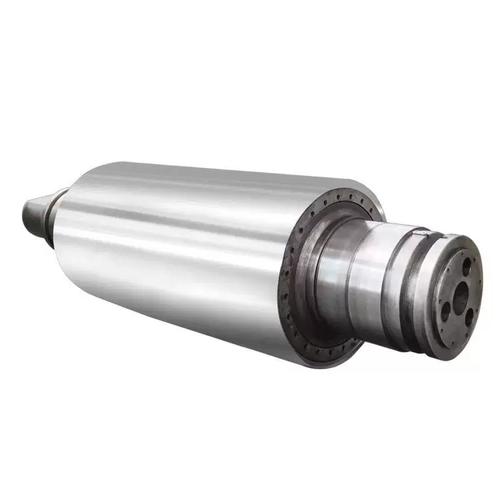
Operators often compare standard cast rolls against forged steel alternatives for aluminum sheet production. Cast rolls, including those produced via centrifugal casting, lack the microstructural density required for modern automotive standards. They are prone to internal porosity, segregation of alloying elements, and uneven wear patterns across the barrel. These inherent casting flaws become catastrophic under the extreme, concentrated pressures of cold rolling high-strength aluminum alloys. Cast rolls simply cannot provide the uniform hardness and structural integrity needed for high-speed, high-reduction operations.
Forged Steel Cold Rolling Work Rolls dominate the automotive sector for clear metallurgical reasons. The forging process, utilizing high reduction ratios from the initial ingot, eliminates internal voids and porosity. It provides superior grain refinement throughout the entire roll body, from the core to the surface. This refined, directional microstructure delivers the high fracture toughness necessary for high-speed cold rolling mills. Forged rolls handle intense cyclic loading and sudden stress spikes—such as those occurring during a strip break or a mill wreck—without sudden, catastrophic failure.
The MC5 alloy represents the industry standard for these demanding applications. An MC5 Cold Rolling Work Roll typically contains 3% to 5% Chromium, heavily alloyed with Molybdenum and Vanadium. This specific chemical composition creates a highly stable matrix supporting complex M7C3 and M23C6 carbides. The resulting microstructure provides an optimal balance of deep hardenability and exceptional wear resistance. The high chromium content ensures that the hardness drops off very slowly as the roll is ground down over its lifespan, maximizing the usable diameter.
MC5 rolls also exhibit strong resistance to thermal shock. During cold rolling, friction in the roll bite generates intense localized heat, which is immediately quenched by the rolling coolant headers. This continuous, rapid thermal cycling induces severe surface stresses. The specialized carbide structure and tempered martensitic matrix of the MC5 grade resist the formation of thermal fatigue cracks. This prevents surface cracking when localized heat generates in the roll bite, ensuring the roll maintains a flawless surface finish over extended production campaigns.
Procurement and engineering teams need a strict framework to assess roll specifications. Evaluating an Aluminum Plate Cold Rolling Work Roll requires looking past basic dimensional drawings. You must analyze specific metallurgical features and map them directly to operational outcomes on the mill.
Evaluation Dimension | Technical Requirement | Operational Outcome |
|---|---|---|
Hardness Uniformity | Consistent Shore C/Leeb readings across barrel | Predictable wear and reliable maintenance |
Roll Stiffness | High resistance to bending under force | Uniform sheet thickness and gauge control |
Roughness Retention | Stable carbide microstructure for EDT | Consistent Class A surface finish |
Spalling Resistance | High fracture toughness and thermal stability | Prevention of catastrophic roll failure |
Microstructural Cleanliness | Vacuum degassed steel production | Elimination of surface defects |
Hardness depth and uniformity dictate the roll's functional lifespan and total tonnage output. You need consistent Shore C or Leeb hardness across the entire barrel length. This consistency must extend deep into the usable diameter, often requiring a hardness drop of less than 2-3 points Shore C over 20mm of radial depth. Uniform hardness ensures predictable wear during the roll's lifecycle. It allows operators to schedule maintenance accurately and prevents unexpected surface degradation. If the hardness varies across the barrel, the roll will wear unevenly, creating a localized depression that ruins the flatness of the aluminum sheet.
Roll stiffness and deflection control are critical for wide automotive panels. The roll must maintain precise crown profiles under extreme rolling forces. High Young's Modulus and specific barrel-to-journal geometries are required to resist bending moments. If the roll deflects excessively, the aluminum sheet will suffer from severe profile issues, requiring the AGC system to overcompensate. High-stiffness forged rolls prevent this deflection, ensuring uniform thickness across the entire coil width, which is an absolute requirement for automotive structural components.
Shifting focus from unit price to manufacturing capability is essential for long-term operational stability. You must evaluate technical scalability, metallurgical expertise, and strict quality assurance protocols. A reliable Forged Roll Manufacturer acts as a strategic partner, deeply integrated into your mill's continuous improvement programs, rather than just a parts supplier.
Assess the manufacturer's production capacity and supply chain scalability. Continuous automotive coil production requires a steady, high-volume supply of replacement rolls. The supplier must meet these demands without compromising lead times, even during raw material shortages. They must source high-grade, vacuum-degassed steel ingots reliably. Delays in roll delivery directly cause mill downtime, forcing operators to extend roll campaigns beyond safe limits, which drastically increases the risk of spalling.
Heat treatment and quenching expertise differentiate top-tier manufacturers from standard machine shops. Dual-frequency induction hardening provides precise control over the hardened depth and the transition zone between the hard shell and the tough core. Specialized quenching techniques, utilizing controlled polymer quenchants or high-pressure water sprays, prevent internal stresses that lead to premature failure. Audit the supplier's heat treatment facilities to verify their technical competence. They must demonstrate strict temperature control during austenitizing and precise tempering cycles to relieve residual manufacturing stresses.
Integrating new cold rolling rolls into an existing mill presents immediate operational risks. You must manage these realities proactively to prevent initial production losses and ensure a smooth transition. Upgrading to high-alloy rolls like MC5 requires immediate, calculated adjustments in the roll shop and the mill operating procedures.
Compile your current mill specifications, including maximum rolling forces, speed ranges, and target 5000/6000 series aluminum grades.
Gather historical roll wear data, mapping out your most frequent failure modes such as spalling, rapid wear, or surface defects.
Audit your internal roll shop capabilities to ensure your grinding equipment and coolant systems can properly process high-alloy forged steel.
Initiate a Custom Cold Rolling Roll Inquiry with a qualified manufacturer using your compiled technical data.
Establish a trial campaign protocol to monitor the new rolls' performance, focusing on surface roughness retention and gauge control improvements.
A: The ideal hardness typically ranges between 90 and 95 Shore C. This specific range balances the exceptional wear resistance needed for continuous production with sufficient fracture toughness. Exceeding this hardness increases brittleness, raising the risk of catastrophic spalling under heavy reduction drafts. Lower hardness leads to rapid wear, loss of surface texture, and frequent roll changes.
A: Cold rolling occurs at room temperature, inducing severe work hardening in the aluminum. This significantly enhances the metal's tensile and yield strength. Because the aluminum becomes exponentially harder to compress with each pass, cold rolling requires rolls with substantially higher fracture toughness, stiffness, and pressure regulation capabilities compared to standard hot mill rolls.
A: Forged steel rolls possess a highly refined, dense microstructure devoid of internal voids, porosity, or severe elemental segregation. This structural integrity provides superior fracture toughness. It allows forged rolls to maintain precise surface finishes and withstand the extreme, cyclic pressures of cold rolling without failing, which cast rolls cannot reliably achieve.
A: An MC5 roll contains a higher chromium content, typically between 3% and 5%, along with molybdenum and vanadium. This specific alloy composition provides a much deeper hardening depth and significantly improved wear resistance. The optimized complex carbide distribution in MC5 also offers superior resistance to thermal shock and surface degradation during high-speed rolling.
A: Spalling is primarily caused by thermal shock, localized mechanical overloading, or sub-surface fatigue. When intense pressure or heat generates micro-cracks beneath the roll surface, continuous cyclic loading forces these cracks to propagate upward. High-quality forging, vacuum-degassed steel, and precise heat treatment are essential to prevent the microstructural weaknesses that lead to spalling.
A: To ensure an accurate engineering specification, you must provide your specific mill type, exact barrel dimensions, and journal specifications. Additionally, detail the target aluminum alloys you process, maximum rolling forces, required hardness depth, preferred surface finish requirements, and historical data on your current roll failure modes.


