Views: 80 Author: Site Editor Publish Time: 2026-06-02 Origin: Site


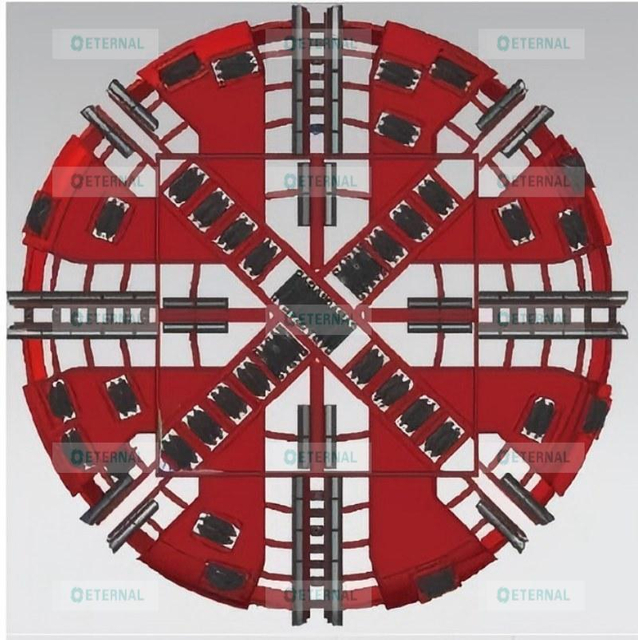
During the reaming operation of a raise boring machine, the cutter head is driven to rotate and exert an upward pull-back force by the rig. Under the combined action of rotation and upward pulling force, the roller cuters mounted on the cutter head roll purely or produce slight displacement along the rock working face at the shaft bottom, generating impact loads. The cutter inserts crush rock via impact, extrusion and shearing effects. Under contact stress, cracks initiate and propagate inside rock, and finally the broken rock forms cuttings which are discharged out of the shaft.

Roller cuters for raise boring machines are mainly categorized into the following types according to insert material and structural configuration:
Tungsten carbide insert cutters are the most widely used type at present. Their inserts are made of cemented carbide and press-fitted into pre-machined insert holes on the cutter wheel body via interference fit. Featuring high hardness and excellent wear resistance, cemented carbide inserts can efficiently crush hard rock. Based on insert profiles, they are subdivided into spherical inserts, conical inserts, wedge inserts and ballistic inserts, applicable to formations with varying rock hardness respectively.
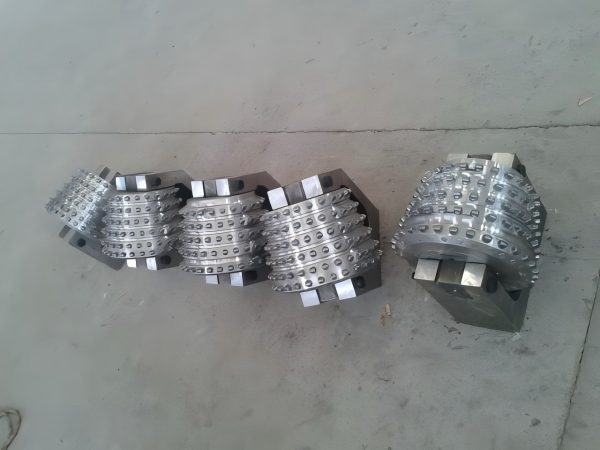
As a newly developed structure in recent years, composite steel tooth cutters feature gauge teeth and inner cutting teeth integrally formed with the wheel body adopting a wedge-shaped tooth profile, with a wear-resistant alloy cladding deposited on the tooth back. This structure boasts multiple merits: tall and stable tooth height delivers superior cutting efficiency; simple construction reduces manufacturing costs; it is particularly suitable for raise boring in soft to medium-hard rock formations.
In line with the number of insert rows, cutters fall into single-row and multi-row types. Single-row insert cutters feature a simple structure and suit medium-hard rock; multi-row insert cutters achieve higher rock-breaking efficiency and longer service life for hard and extremely hard rock formations.
The key-and-pin combined positioning structure is a vital technical solution developed in recent years. Multiple sets of positioning keys and pins are assembled to realize positional connection between cutter saddle and cutter head bracket: the upper ends of keys and pins are transition-fitted with the cutter saddle while their lower ends are interference-fitted with the cutter head bracket to form stepped positioning.
This design brings three prominent advantages:
Firstly, reliable positioning effectively prevents swinging and spinning of cutter saddles induced by rotational torque during reaming;
Secondiy, shear loads are borne by positioning keys and pins to protect fastening bolts from shear failure;
Thirdly, threaded holes are machined between keys and pins to facilitate disassembly and replacement and improve the interchangeability of cutter saddles.
For bearing systems, high-end roller cuters commonly adopt bespoke cartridge bearings or combined bearing assemblies (e.g., tapered roller bearings matched with thrust bearings) to sustain radial and axial loads simultaneously.
Sealing technology constitutes one of the decisive factors governing cutter service life. Modern high-efficiency cutters for deep hard-rock boring employ pre-stressed self-compensating composite metal rotary sealing technology. By investigating pre-stress application modes and quantitative characteristics of seals, the geometric distribution and responsive performance of sealing stress are optimized to achieve adaptive sealing performance, drastically extending sealing service life and guaranteeing continuous shaft construction.
In terms of lubrication systems, grease filling holes are integrated into locking plugs which are installed into corresponding holes on the wheel body. This design eliminates redundant grease accumulation inside bearing chambers arising from the traditional axial filling layout and optimizes internal bearing lubrication.
An advanced innovative design is the oil storage compensation and balance system. Vibration generated during cutter operation creates suction inside bearing assemblies, while slurry pressure acts on the oil storage bladder. Lubricant inside the bladder is continuously fed through oil guide channels into holding cavities to lubricate bearing components. The system balances pressure differential between the inside and outside of holding cavities during operation, enabling normal sealing function under low differential pressure to block drilling fluid ingress and lubricant leakage, as well as storing sufficient grease for continuous replenishment into cavities.
Insert profile design directly determines rock-breaking efficiency and formation adaptability of cutters. While spherical and conical inserts dominated conventional cutters, wedge inserts have gained growing popularity in recent years.
Wedge inserts have distinct characteristics: tall tooth height produces intensive stress concentration to facilitate crack initiation and expansion in rock, delivering high cutting efficiency alongside simple geometry for easy machining and fabrication.
For insert layout, staggered arrangement fully covers the rock fracturing zone at shaft bottom to produce fine and uniform rock cuttings for improved slag removal. The combined layout of gauge teeth and inner cutting teeth balances borehole wall protection and high-performance rock breaking.
(1) Higher Efficiency: Optimize insert profiles, insert layout and cutting structures to increase rock breaking volume per unit energy consumption for efficient rock fragmentation.
(2) Extended Service Life: Continuously upgrade bearing, sealing and lubrication technologies to prolong continuous underground working duration of cutters under harsh downhole conditions and reduce replacement frequency.
(3) Intellectualization: Integrate sensors inside cutters to real-timely monitor operating parameters such as working condition, temperature and vibration, providing data support for drilling parameter optimization and early fault warning.
(4) Customization: Develop serialized and tailor-made cutters targeted at diverse geological formations and engineering requirements to achieve customized matching for specific projects.(5) Standardization and Interchangeability: Standardize mounting interface design to enhance interchangeability among cutters from different manufacturers and cut users'spare part inventory costs.
As core rock-breaking components for raise boring construction, roller cuters directly determine the construction efficiency, cost and operational safety of underground engineering. Current technical development of roller cuters has evolved from unilateral improvement of rock-breaking efficiency toward systematic multi-dimensional optimization covering mounting positioning, bearing sealing, insert profiling and lubrication systems.
Sandvik, Epiroc, Herrenknecht, Robbins, Rocksmith, TUMI, TERRATEC, Master Drilling, NFM, etc.
Raise boring machines are critical equipment for underground construction in mining, hydropower, transportation and other industries, widely used for constructing vertical or inclined passages including raises, ore passes and inclined shafts.
Compared with conventional drill-and-blast excavation, raise boring features prominent merits including superior operational safety, high finished shaft quality, faster construction progress and minimal disturbance to surrounding rock mass.