


Views: 0 Author: Site Editor Publish Time: 2026-11-25 Origin: Site


The transition to high-energy-density lithium-ion batteries requires ultra-thin copper foils (typically 6–12 μm) to maximize active material volume and improve long-term cycle stability. Achieving strict thickness tolerances and sub-1.5 μm surface roughness on high-purity copper (typically 99.8% Cu or above) at high production speeds is mechanically demanding. Minor deviations in rolling equipment lead to micro-chipping, copper dust generation, and high scrap rates. The primary variable controlling these critical dimensions is the quality, material, and precision of the battery copper foil work rolls. Evaluating roll metallurgy, manufacturing processes, and supplier capabilities is essential for foil manufacturers aiming to stabilize production and protect profit margins.
Precision Dictates Performance: The surface finish and dimensional stability of battery copper foil work rolls directly control the foil's final thickness, electrical stability, and active material adhesion properties.
Material Superiority: Cr3 (3% Chromium) forged steel is the baseline standard for cold rolling ultra-thin foils due to its optimal balance of wear resistance and deep hardenability.
Manufacturing Integrity: Forged rolls eliminate the microstructural voids found in cast alternatives, preventing catastrophic spalling under high rolling loads.
Supplier Evaluation: Selecting a vendor requires auditing their forged roll manufacturing capabilities, specifically their heat treatment consistency and precision grinding tolerances.
Battery-grade copper foil must meet uncompromising mechanical and electrical specifications before it ever reaches a coating line. The success criteria include uniform thickness across the entire strip width, high tensile strength to withstand battery winding processes, specific surface roughness profiles, and a minimum purity of 99.8%. Any deviation from these parameters compromises the foil's performance as an anode current collector. The rolling mill applies massive compressive forces evenly across the strip. This requires tooling that resists deformation, maintains its surface texture, and transfers zero defects to the foil. Mill operators rely on the Battery Copper Foil Work Rolls to act as the absolute reference surface during the final reduction passes.
Achieving a target gauge of 6 to 12 μm relies entirely on the rigidity and profile of the Copper Foil Rolling Mill Work Roll. As the copper strip enters the roll bite, the work rolls apply compressive force to plastically deform the metal. Under these extreme separating forces, the rolls naturally deflect or bend. If this deflection is not perfectly countered by the roll's initial camber (crown) and the mill's bending blocks, the resulting foil suffers from gauge variations such as edge drop or center buckle.
These thickness inconsistencies directly compromise the battery's electrical stability. Uneven foil thickness creates localized variations in electrical resistance. During high-rate charging or discharging, thinner sections experience higher current density. This uneven current distribution generates localized hot spots. Over time, these hot spots accelerate lithium plating and degrade the battery's overall lifespan and safety profile. Automatic Gauge Control (AGC) systems can adjust roll gap dynamically, but they cannot compensate for a roll that bends unevenly or suffers from excessive runout.
The surface topography of the work roll transfers directly to the copper foil. Battery manufacturers require a foil surface roughness strictly below 1.5 μm. This specific texture ensures optimal adhesion of the active anode materials. If the foil is too smooth, the slurry will not bond mechanically. If the roughness exceeds 1.5 μm, the peaks and valleys create uneven coating thicknesses across the current collector.
This adhesion requirement becomes even more demanding for advanced silicon-carbon anodes. Silicon experiences massive volume expansion—often up to 300%—during the charging cycle. If the copper foil lacks the precise surface profile generated by a perfectly ground work roll, the expanding active material delaminates from the current collector. Delamination severs the electrical pathway, leading to rapid capacity fade and premature battery failure. Roll shops must utilize advanced grinding wheels to impart the exact Ra and Rz roughness values required by the end user.
Rolling 99.8% pure copper introduces specific tribological challenges on the mill floor. High-purity copper is exceptionally ductile and highly prone to adhesive wear. It tends to stick or cold-weld to the work roll surface under high pressure. To prevent this material transfer, the work roll must maintain an optimized, flawless surface texture and work in perfect harmony with the rolling lubricant.
If the roll surface degrades or develops microscopic asperities, copper particles adhere to the steel. These adhered particles then emboss the incoming strip, creating repeating dent marks. Maintaining the exact surface finish on the roll prevents this sticking phenomenon. It ensures the foil remains pristine while allowing the mill to run at maximum design speeds without strip breaks.
Operating with sub-optimal or degraded work rolls carries a heavy financial penalty. When a roll surface becomes dull, micro-chipped, or unevenly worn, it generates excessive copper dust during the rolling process. This fine dust contaminates the rolling oil system, embeds itself into the foil surface, and creates severe issues during downstream slitting operations.
Contaminated foil fails quality control inspections and ends up as scrap. Furthermore, the presence of copper dust accelerates wear on slitter blades. Operators are forced to stop the line frequently to change blades or swap out damaged rolls. This drags down Overall Equipment Effectiveness (OEE) and drives up maintenance overhead. Precision tooling prevents these cascading failures.
Metallurgical selection dictates how a roll behaves under the punishing conditions of a cold reduction mill. The primary categories for cold rolling mill rolls include standard alloy steels, high-speed steels, and high-chromium forged steels. For ultra-thin copper foil applications, high-chromium forged steels dominate the industry. They offer the necessary microstructural density and wear characteristics required to maintain tight tolerances over long production runs.
The chemical composition of the roll material defines its operational limits. A Cr3 Cold Rolling Work Roll utilizes approximately 3% chromium, alloyed with carbon, molybdenum, and vanadium. This specific chemistry allows for the precipitation of fine, hard chromium carbides throughout the steel matrix during heat treatment.
These carbides provide superior wear resistance against the abrasive action of the copper strip. Simultaneously, the 3% chromium content ensures deep hardenability while maintaining the core toughness required to absorb high-frequency rolling shocks and torsional stresses. This balance prevents the roll from shattering under heavy reduction passes while keeping the surface intact for extended periods. The molybdenum adds high-temperature stability, preventing the roll from losing hardness when friction generates localized heat in the bite.
Specifying the correct roll hardness involves navigating a strict trade-off between wear resistance and fracture toughness. Hardness is typically measured on the Shore C or Leeb scales on the shop floor. A higher surface hardness reduces the rate of abrasive wear and helps the roll resist indentations from foreign particles. However, pushing the hardness too high makes the hardened layer brittle, significantly increasing the risk of catastrophic spalling under heavy loads.
The roll's hardness also dictates its ability to overcome the strain hardening of the copper foil. As copper is cold-rolled, dislocations build up within its crystal lattice, increasing its yield strength. The work roll must remain rigid enough to apply the necessary force to deform this strain-hardened copper without flattening elastically in the roll bite. Engineers specify a hardness range that balances the need to deform the foil against the risk of brittle roll failure.
Campaign length—the total tonnage or linear meters rolled between mandatory regrinding cycles—serves as a primary metric for rolling mill efficiency. Specifying the right Cr3 chemistry and heat treatment directly extends this campaign length. A roll that maintains its surface profile and roughness for an extra 24 hours of continuous operation drastically reduces downtime.
Longer campaigns mean fewer roll changes, less handling damage, and higher OEE. It also stabilizes the thermal conditions of the mill. Frequent roll changes require the mill to ramp down and lose its thermal equilibrium. Optimizing wear resistance through proper material selection keeps the mill running steadily, producing on-gauge foil with minimal interruption.
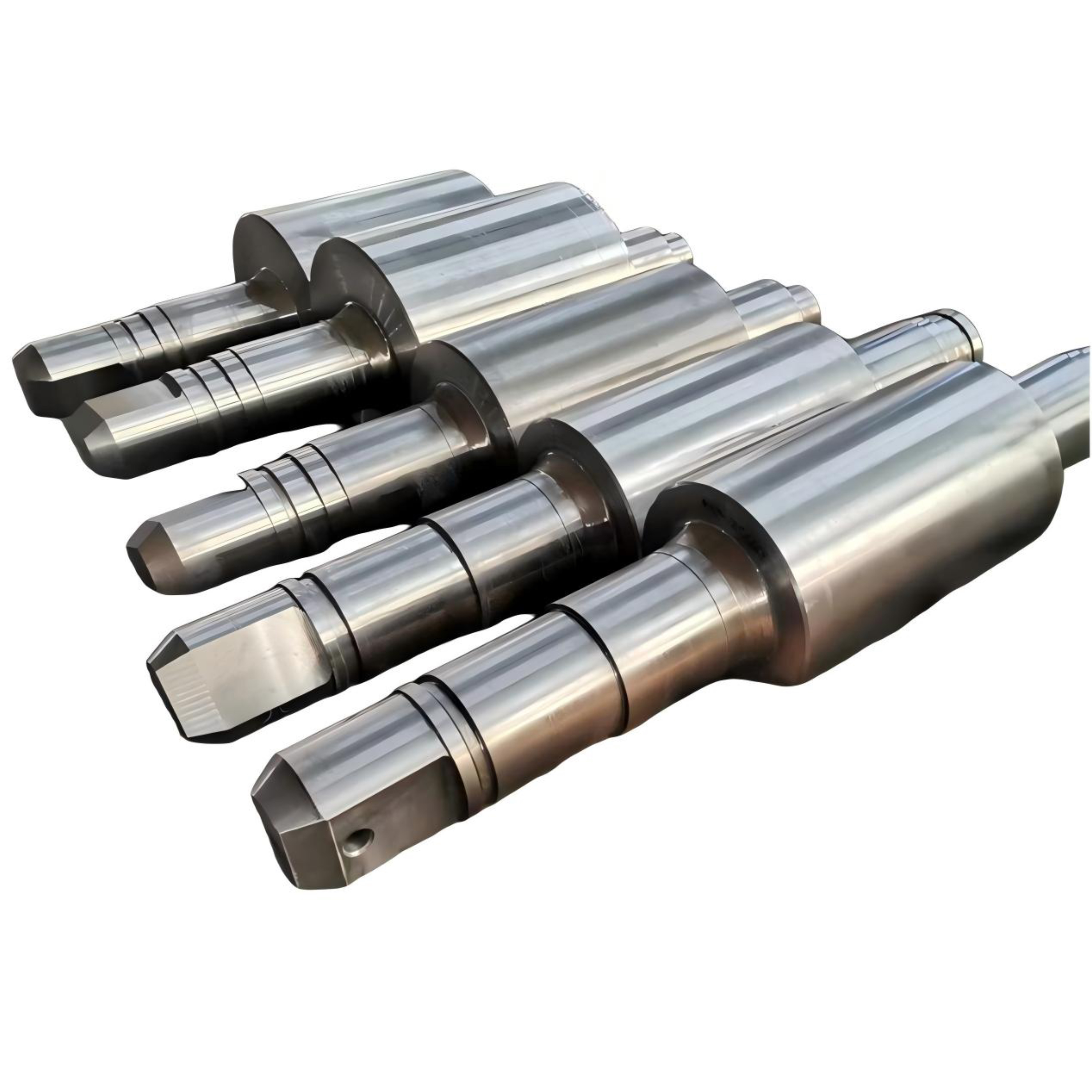
When outfitting a mill for battery foil, engineering teams evaluate the fundamental manufacturing method of the rolls. Comparing a Forged Cold Rolling Mill Roll against cast iron or cast steel alternatives reveals stark differences in performance. For ultra-thin applications, the evaluation dimensions focus on microstructural integrity, elastic modulus, and thermal behavior.
Performance Feature | Forged Steel Rolls | Cast Rolls | Impact on 6–12 μm Copper Foil |
|---|---|---|---|
Microstructure | Dense, refined grain, zero internal voids. | Dendritic structure, prone to microporosity. | Prevents microscopic surface defects from transferring to the foil. |
Dimensional Stability | High resistance to elastic flattening in the bite. | Lower modulus, prone to deformation under load. | Ensures uniform thickness and prevents edge drop. |
Thermal Conductivity | High and uniform heat transfer. | Variable heat transfer due to alloy segregation. | Allows precise control of the thermal crown for flat strip profiles. |
Fatigue Resistance | Excellent resistance to cyclic stress. | Lower threshold for subsurface crack initiation. | Reduces the risk of spalling and catastrophic mill wrecks. |
Regrindability | Deep, uniform hardened layer allows multiple grinds. | Hardness drops off quickly below the cast surface. | Lowers tooling replacement costs over the mill's lifespan. |
The forging process applies immense compressive force to the steel ingot at high temperatures. This mechanical working breaks down the coarse, as-cast dendritic grain structure and closes any internal voids or porosity. The result is a highly refined, dense, and isotropic microstructure.
This microstructural integrity is non-negotiable for battery foil production. When rolling copper down to 6 μm, even a microscopic pinhole or non-metallic inclusion on the roll surface prints a defect onto the foil. Cast rolls inherently carry a higher risk of microporosity. Forged rolls eliminate this variable entirely, providing a flawless canvas that ensures the foil meets strict battery-grade quality standards.
Cold reducing copper foil requires massive separating forces. Under this pressure, the work roll undergoes elastic deformation, flattening slightly in the contact zone. Forged steel exhibits superior elastic modulus and yield strength compared to cast alternatives. It resists this flattening effect more effectively.
By maintaining its cylindrical shape under extreme loads, a forged roll ensures a uniform pressure distribution across the entire width of the copper strip. This dimensional stability prevents the roll from bending excessively, which mitigates edge drop and ensures the foil maintains a perfectly rectangular cross-section. Consistent thickness across the width is mandatory for stable battery winding and uniform current density.
During high-speed rolling, the plastic deformation of the copper and the friction in the roll bite generate intense heat. The work roll absorbs this heat and expands thermally, creating a thermal crown. Operators rely on cooling headers to manage this expansion and maintain the desired roll profile.
Forged steel offers predictable and uniform thermal conductivity. Heat dissipates evenly through the dense microstructure, allowing the thermal crown to develop symmetrically. Cast rolls, with their potential for alloy segregation and porosity, expand unevenly. This leads to localized tight edges or center buckles in the foil. The predictable thermal behavior of forged rolls enables operators to maintain strict flatness tolerances during continuous, high-speed campaigns.
Procurement and engineering teams execute rigorous technical audits before approving a Battery Copper Foil Roll Supplier. The supplier must prove they possess the heavy machinery, metallurgical expertise, and quality control systems required to produce precision tooling at scale. Evaluating a vendor goes beyond checking a specification sheet. It requires verifying their internal processes, from steel melting and vacuum degassing to final inspection.
The final geometry and surface finish of the roll dictate the quality of the copper foil. Suppliers operate advanced CNC roll grinders equipped with hydrostatic bearings and in-process measurement systems. These machines achieve exact camber profiles—often measured in single-digit microns—to counteract roll deflection under load.
The supplier must demonstrate the ability to achieve flawless surface finishes. Grinding a roll to a mirror finish or applying a specific texture requires precise control over grinding wheel selection, feed rates, and coolant application. If the supplier cannot consistently hold surface roughness tolerances well below the 1.5 μm foil requirement, they cannot support battery-grade production.
Heat treatment separates acceptable rolls from exceptional ones. Evaluating Forged Roll Manufacturing Capabilities requires a deep dive into the vendor's induction hardening processes. Dual-frequency induction hardening is the preferred method for Cr3 rolls. Low-frequency induction heats the steel deeply, while high-frequency induction concentrates on the surface.
This dual approach creates a uniform, deep hardened layer. A consistent hardening depth is a core metric of supplier capability. It dictates how many times the roll can be reground in the mill's maintenance shop before the softer core material is exposed. A supplier that guarantees a deep, uniform hardened layer provides a roll with a significantly longer total lifecycle.
A roll may look perfect on the outside but harbor dangerous subsurface defects. Mandatory QA protocols certify the internal integrity of every roll before it ships. Suppliers utilize comprehensive Non-Destructive Testing (NDT) methods to validate their forging and heat treatment cycles.
Ultrasonic Testing (UT), often utilizing phased array technology, scans the internal volume of the roll to detect inclusions, voids, or deep cracks. Magnetic Particle Inspection (MPI) or dye penetrant testing verifies the surface and near-surface integrity. You must demand detailed NDT reports with every roll delivery. Installing a roll with an undetected subsurface crack invites catastrophic failure, mill damage, and massive production losses.
Deploying high-precision work rolls exposes the mill to operational realities and maintenance challenges. Roll marks are a constant threat. These repeating defects on the foil are typically caused by foreign particle ingress, rolled-in scale, or lubrication failure. When a hard particle passes through the bite, it dents the roll surface. That dent then embosses every subsequent meter of foil.
Uneven rolling thickness or edge drop caused by localized roll wear severely complicates downstream processing. When the foil edges are thinner than the center, the strip winds unevenly, causing telescoping coils. Uneven thickness causes the slitting blades to cut poorly, generating secondary copper dust. Mills establish strict protocols for continuous inline surface inspection using high-speed cameras to catch roll marks the moment they occur.
Spalling—the violent detachment of a piece of the hardened roll surface—is the most severe failure mode in cold rolling. It destroys the roll, ruins the copper strip, and often damages the backup rolls and mill bearings. Spalling is typically caused by improper pre-heating, severe mill wrecks, or exceeding the roll's fatigue limits.
Mitigation requires strict operational discipline. Rolls must be properly warmed up to operating temperature before heavy reductions are applied, preventing thermal shock. Operators monitor rolling loads constantly. If a mill wreck occurs, the rolls are removed immediately and subjected to eddy current testing or UT in the roll shop to detect any subsurface cracks initiated by the wreck. Grinding out these micro-cracks prevents them from propagating into a full spall during the next campaign.
Maximizing roll life and preserving foil quality requires a data-driven approach to roll maintenance. Relying on fixed timeframes for roll changes often leads to either premature removal or running the roll too long. Maintenance schedules are dictated by tracking the tonnage rolled against measured surface degradation.
Measure the profile and roughness of the rolls immediately after removal from the mill.
Analyze the wear data to determine the exact depth of the fatigued surface layer.
Set the CNC grinder to remove only the minimum required diameter to restore the profile and eliminate micro-cracks.
Perform a final eddy current inspection post-grind to verify no residual fatigue cracks remain.
Log the total tonnage and diameter reduction to track the roll's lifecycle efficiency.
Battery copper foil thickness, electrical stability, and surface quality are inextricably linked to the metallurgical and dimensional perfection of the work rolls. Achieving 6–12 μm gauges with sub-1.5 μm roughness on 99.8% pure copper leaves no room for tooling errors. Deflection, thermal instability, or surface defects on the roll immediately translate to rejected coils, excessive copper dust, and compromised battery performance. Selecting the right tooling supplier requires strict technical auditing. Prioritize vendors with proven forged roll manufacturing capabilities, verifiable Cr3 heat treatment data demonstrating deep induction hardening, and uncompromising NDT protocols.
Audit your current roll campaign lengths and cross-reference them with scrap data related to surface defects and slitting dust to identify tooling-related losses.
Implement continuous inline surface inspection systems to detect roll marks instantly, preventing the production of defective coils.
Establish a data-driven roll grinding schedule based on tonnage and measured surface degradation rather than fixed time intervals.
Request detailed metallurgical certifications, including UT and induction hardening depth reports, from all prospective roll suppliers before issuing purchase orders.
A: Work rolls must be ground to a mirror finish, often well below the final foil requirement of <1.5 μm. This accounts for transfer dynamics, inevitable wear during the campaign, and the need to create a precise surface topography that ensures optimal active material adhesion without causing slurry pooling or delamination.
A: Bending under load causes center fullness or edge drop, requiring precise roll crowning and bending blocks to counteract. Uneven thickness leads to unstable electrical connections and uneven current density in the final battery, which accelerates localized heating and lithium plating.
A: Forged steel provides a dense, void-free microstructure resulting from heavy mechanical reduction. This eliminates the microporosity found in cast rolls, preventing microscopic surface defects from transferring to the highly ductile, 99.8% pure copper foil during extreme reduction passes.
A: Micro-chipping results from excessive surface hardness making the layer brittle, localized stress concentrations from rolled-in foreign particles, or subsurface fatigue caused by continuous high-reduction passes exceeding the material's yield limits.
A: Regrinding intervals depend on rolling speeds, reduction ratios, and strict surface quality limits. They should be dictated by continuous surface inspection data and tonnage tracked against surface degradation, rather than fixed timeframes, to maximize roll life and foil yield.
A: A deeper, uniform hardened layer allows the roll to be reground multiple times in the maintenance shop without exposing the softer core material. This preserves the roll's wear-resistant properties over a longer total lifecycle, maximizing the return on tooling investment.


