


Views: 0 Author: Site Editor Publish Time: 2026-11-20 Origin: Site


In cold reduction mills, the metallurgical integrity of the work roll directly dictates strip surface quality, gauge consistency, and overall mill uptime. Procurement engineers and plant managers must balance initial tooling costs against campaign longevity. The decision often comes down to selecting between the traditional 3% Chromium (MC3) and the upgraded 5% Chromium (MC5) forged steel grades. Make the wrong choice, and you face premature spalling, excessive regrinding, or unnecessary capital expenditure. This guide provides a direct technical comparison of MC3 vs MC5 Cold Rolling Work Rolls. We evaluate wear resistance, contact fatigue limits, and operational variables to help buyers specify the correct metallurgy for their specific mill applications.
Chromium Content Drives Performance: The primary differentiator is the chromium percentage (approx. 3% in MC3 vs. 5% in MC5), which fundamentally alters the roll's hardenability and wear profile.
Fatigue and Spalling Resistance: MC5 offers superior resistance to repetitive contact fatigue, making it the standard for rolling harder materials like stainless steel or advanced high-strength steels (AHSS).
Lifecycle Economics: While an MC3 Forged Steel Work Roll presents a lower initial procurement cost, MC5 often yields a lower lifecycle expense in high-stress applications due to extended campaign lengths and deeper usable hardened layers for regrinding.
Supplier Capabilities Matter: The theoretical advantages of either grade are only realized through precise heat treatment and rigorous non-destructive testing (NDT) by a qualified forged work roll supplier.
Unlike hot rolling, cold rolling operates at room temperature to transform thick hot-rolled bands into thinner, more precise sheets. This bulk deformation process places immense compressive forces and friction on the opposing work rolls. When the steel strip enters the roll bite, the specific pressure easily exceeds 1000 MPa. The roll material must possess high surface hardness to maintain dimensional precision while retaining core toughness to prevent catastrophic breakage under these extreme loads.
Chromium serves as the primary alloying element to combat this severe mechanical environment. It forms hard carbides that resist abrasion and provides the hardenability necessary to achieve a deep, uniform martensitic case during the quenching process. The exact percentage of chromium dictates the volume fraction and morphology of these carbides, directly influencing how the roll behaves on the mill stand.
The baseline metallurgical profile of this grade contains approximately 3% Chromium, alloyed with Molybdenum and Vanadium. It provides a reliable hardened depth and excellent surface finish capabilities under standard compressive loads. Historically, this has been the long-standing industry standard for conventional cold rolling of mild and carbon steels.
On the shop floor, MC3 is the traditional workhorse. It grinds predictably in the roll shop without requiring exotic abrasive wheels. Operators know exactly how it responds to standard reductions on low-carbon steel. It handles normal thermal expansion well and maintains a stable profile during routine campaigns. For mills processing standard gauges of mild steel, MC3 delivers consistent, repeatable performance without over-engineering the tooling.
The upgraded metallurgical profile increases the Chromium content to roughly 5%. This seemingly small addition significantly enhances the formation of hard, wear-resistant chromium carbides, specifically shifting the microstructure to favor M7C3 carbides. This achieves a deeper, more uniform hardness profile and superior resistance to thermal and mechanical shocks.
Metallurgists developed this grade to meet the increasing demands of modern, high-speed tandem mills and the extreme compressive forces required for harder strip materials. The extra chromium fights off the micro-welding and galling that occurs when rolling sticky materials like stainless steel. While an MC5 Forged Steel Work Roll requires more careful grinding parameters to avoid burning the surface, it stays in the mill stand much longer, handling higher reduction ratios without degrading.
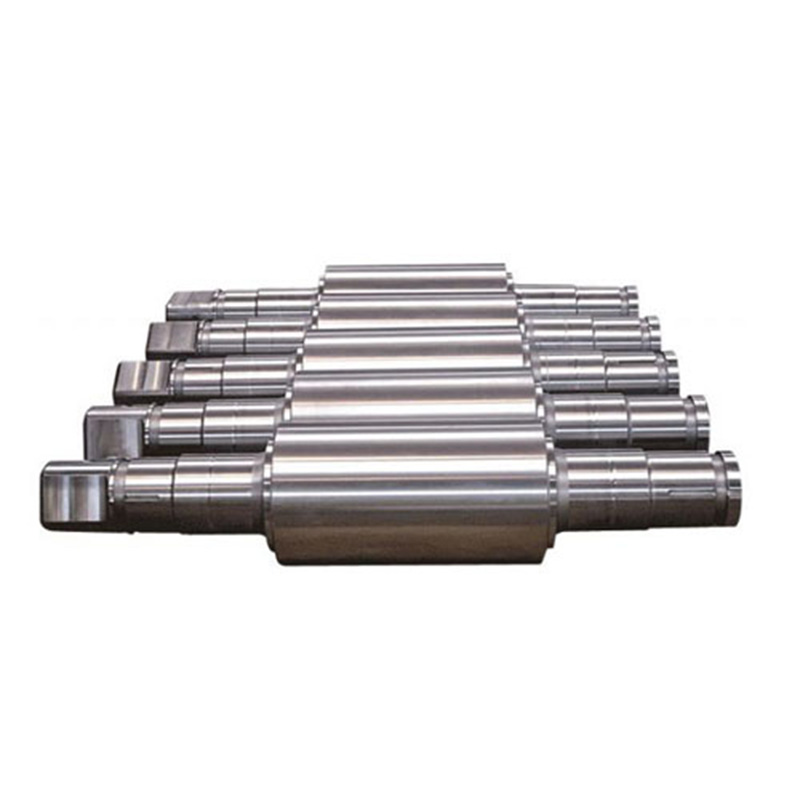
To specify the correct tooling, you must evaluate these two grades across the specific failure modes and performance metrics that dictate cold rolling operations. We compare them based on wear, fatigue, and surface retention.
MC3 provides adequate wear resistance for standard campaigns. However, it requires more frequent roll changes when processing abrasive or high-tensile materials. Oxide scale remaining on the strip after pickling acts as an abrasive, slowly degrading the roll surface. MC3 handles this up to a point, but the surface roughness will eventually drift out of specification.
MC5 features a higher carbide density that significantly reduces the wear rate. It maintains surface texture and crown profile over longer tonnage runs. When a roll wears, it loses its mechanical crown, which leads to edge wave or center buckle in the rolled strip. Because MC5 holds its crown longer, operators spend less time chasing strip shape with roll bending systems or coolant header adjustments. The mill runs faster and more stable.
Performance Metric | MC3 (3% Cr) | MC5 (5% Cr) |
|---|---|---|
Carbide Volume Fraction | Moderate | High |
Abrasive Wear Resistance | Standard | Excellent |
Crown Retention | Average | Superior |
Typical Campaign Length | Baseline | 1.5x to 2x Baseline |
Spalling is the most severe failure mode in cold rolling. Continuous high-pressure contact leads to sub-surface micro-cracking. The Hertzian contact stresses peak slightly below the roll surface. If the hardness drops off too quickly in that transition zone, the shear stresses exceed the material's yield strength. A crack initiates, propagates parallel to the surface, and eventually turns upward, blowing a chunk of steel out of the roll face.
MC3 has shallower hardness gradients, making the transition zone susceptible to fatigue under extreme rolling loads. If the mill takes a heavy reduction, the stress penetrates deep into the roll shell, risking a spall.
MC5 provides higher fracture toughness at elevated hardness levels. The 5% Cr matrix pushes the functional hardness deeper into the roll body, moving the transition zone safely away from the peak stress depth. This delays the onset of contact fatigue and minimizes spalling risks, protecting both the work roll and the expensive backup rolls from collateral damage.
Both grades can be polished to the high mirror finishes required for cold-worked products. Standard grinding and polishing techniques easily bring both MC3 and MC5 down to low Ra values for rolling bright finish strip.
However, polishing for special applications reveals the differences. MC5 possesses a finer, more evenly distributed carbide structure. This allows for superior retention of specialized surface textures and high-gloss finishes during extended runs. When using Electrical Discharge Texturing (EDT) or shot blasting to impart a specific roughness for exposed auto body panels, MC5 holds the microscopic crater edges sharper for longer. MC3 loses its texture faster, forcing a roll change simply to maintain surface specifications, even if the roll remains dimensionally sound.
Aligning the metallurgical choice with the specific operational realities of your rolling mill prevents both under-performance and over-spending. You must look at the material entering the bite and the geometry of the mill itself.
Tinplate and mild carbon steel have lower yield strengths and predictable deformation behaviors. MC3 remains highly viable and cost-effective for these materials. The separating forces stay within normal limits, and the abrasive wear is minimal. Upgrading to MC5 for basic tinplate often yields diminishing returns.
Stainless steel and AHSS (Advanced High-Strength Steel) change the equation entirely. The rapidly expanding stainless cold rolling mill market demands rolls that can withstand severe work-hardening rates. Rolling 300-series stainless is brutal on tooling; it work-hardens instantly in the bite, causing separating forces to skyrocket. The higher deformation resistance of these materials necessitates the enhanced wear and fatigue limits of MC5. Using MC3 on AHSS leads to rapid surface degradation and dangerous roll flattening.
Continuous tandem mills and reversing mills place different stresses on Cold Rolling Mill Rolls. Early tandem stands take heavy reductions, generating massive compressive loads. Single-stand reversing mills experience high thermal fluctuations as the strip enters cold, heats up in the bite, and the roll cools on the backside. Both of these environments heavily benefit from MC5, which resists thermal fatigue crack propagation (fire-cracking) better than MC3. Later tandem stands focusing purely on surface finish may utilize either grade depending on the target texture.
Small diameter work rolls face severe limitations. Common in 4-high, 6-high, or Z-mills (Sendzimir mills) for rolling ultra-thin gauges, these small rolls spin at incredibly high RPMs. They undergo significantly more revolutions and stress cycles per ton of steel rolled. This accelerated fatigue accumulation makes MC5 the preferred choice to prevent premature failure. The rapid cycle rate will destroy an MC3 roll through contact fatigue long before it wears out dimensionally.
Mill Configuration | Primary Stress Factor | Recommended Grade |
|---|---|---|
Z-Mill / 20-High | Extreme High-Cycle Fatigue | MC5 |
Reversing 4-High | Thermal Cycling / Fire-Cracking | MC5 |
Tandem Stand 1 & 2 | Heavy Compressive Load | MC5 |
Tandem Stand 4 & 5 | Surface Finish / Texture | MC3 or MC5 |
Moving beyond the initial purchase price is mandatory when evaluating heavy industrial tooling. The cheapest roll on the purchase order often becomes the most expensive roll on the mill floor if it causes downtime.
MC3 offers a lower upfront cost due to lower alloy content and slightly less complex heat treatment requirements. The forging and quenching processes are well-established and highly optimized, keeping manufacturing costs down.
MC5 requires a higher initial capital outlay. However, it reduces hourly mill downtime costs associated with frequent roll changes. A standard roll change takes 10 to 15 minutes. If mill production time is valued at several hundred dollars a minute, eliminating just two roll changes per shift pays for the premium of the MC5 roll rapidly. You are buying machine uptime, not just a piece of steel.
The value of a roll is dictated by how many times it can be dressed (reground) before falling below the minimum hardness specification. A new roll might start at 500mm in diameter with a scrap diameter of 460mm, giving you 40mm of usable hardened depth.
MC5 features a deeper hardenability curve. This means a larger diameter reduction is permissible over the roll's life. Furthermore, because MC5 resists deep micro-cracking, the roll shop does not have to grind away as much material to clean up the surface after a campaign. If you grind off 0.5mm per campaign with MC5 versus 1.0mm with MC3, you effectively double the number of campaigns per roll. This yields significantly more tonnage per roll, driving down the tooling cost per ton of steel produced.
Advanced metallurgical grades are only as effective as the manufacturing process behind them. Poorly controlled forging or heat treatment will completely negate the inherent benefits of a 5% Cr alloy.
Improper quenching leaves dangerous residual internal stresses in the roll body. Retained austenite is a major risk. If the heat treater fails to perform proper cryogenic treatments or tempering cycles, that retained austenite transforms into martensite later while under rolling pressure in the mill. This phase transformation causes a volume expansion, creating massive internal stress that leads to explosive breakage.
To mitigate this, demand documented heat treatment cycles tailored specifically to the MC3 or MC5 chemistry. Dual-frequency induction hardening is highly effective here. Low frequency heats deep into the shell, while high frequency heats the surface, creating a deep, uniform austenitic layer before the aggressive quench. Verify these charts before putting the roll into service.
Traceability is non-negotiable. Ensure the supplier controls the process from ingot casting and ESR (Electro-Slag Remelting) to final forging and machining. ESR removes non-metallic inclusions from the steel. An inclusion near the surface acts as a stress riser and will initiate a spall under heavy rolling loads.
Require comprehensive Quality Assurance and NDT (Non-Destructive Testing) prior to accepting delivery. Ultrasonic testing (UT) is required to find internal flaws, voids, or deep inclusions. Eddy current testing is necessary to detect microscopic surface cracks that are invisible to the naked eye. When you request a custom forged work roll quote, explicitly state your NDT acceptance criteria in the RFQ.
The choice between MC3 and MC5 is not about finding a universally "better" roll, but rather the most economically efficient roll for a specific reduction task. Specify MC3 for standard carbon steel applications where initial cost is a primary constraint, roll wear is predictable, and roll diameters are larger. Specify MC5 for high-reduction mills, small diameter roll configurations, harder alloys like stainless, or operations where maximizing campaign length and minimizing spalling are critical to profitability.
Take the following steps to optimize your mill tooling:
Compile your required roll dimensions, target hardness (Shore C or Leeb), and typical rolled materials into a single technical specification sheet.
Audit your roll shop grinding records to identify the primary failure modes (abrasive wear vs. contact fatigue) of your current roll inventory.
Use this operational data to request a custom forged work roll quote from a certified metallurgical supplier to compare current pricing and lead times for both grades.
Require sample NDT reports, ESR certifications, and heat treatment charts from prospective vendors before issuing a purchase order.
A: The primary difference is the chromium content (3% vs. 5%). MC5 offers deeper hardenability, better wear resistance, and higher resistance to contact fatigue and spalling compared to the traditional MC3 grade.
A: Upgrade to MC5 if your mill experiences premature roll spalling, transitions to rolling harder materials like stainless steel or AHSS, utilizes small diameter rolls that accumulate fatigue quickly, or needs to extend campaign lengths to reduce mill downtime.
A: Yes. Because MC5 steel allows for a deeper and more uniform hardness profile during heat treatment, more material can be ground off the diameter over its lifespan before the roll falls below the minimum required surface hardness.
A: Spalling is typically caused by repetitive contact fatigue. Continuous high-pressure compressive rolling loads create sub-surface micro-cracks that eventually propagate to the surface, causing pieces of the roll to flake off. Higher alloy grades like MC5 resist this effectively.
A: Provide a forged work roll supplier with your engineering drawings, required barrel and neck dimensions, desired material grade, target surface hardness, and details about the material you are rolling to get an accurate quote.
A: Yes, mill operators often mix roll grades across different stands. MC5 is typically used in early stands where compressive forces and wear are highest, while MC3 serves well in finishing stands where the primary focus is imparting a specific surface texture.


